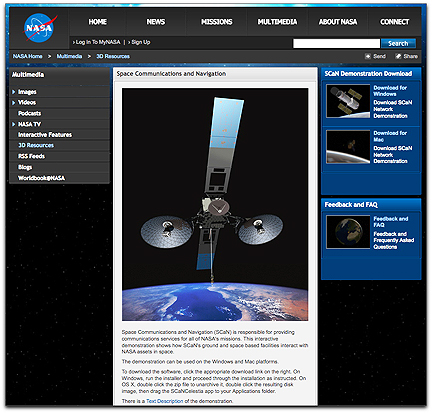
NASA has unveiled an interactive computer simulation that allows virtual explorers of all ages to dock the space shuttle at the International Space Station, experience a virtual trip to Mars or a lunar impact, and explore images of star formations taken by the Hubble Space Telescope. In an effort to excite young people about space and NASA’s missions, the agency has launched the online Space Communication and Navigation
(SCaN) simulation, designed to entertain and educate. The interactive simulation offers a virtual 3-D experience to visualize how data
travels along various space communications paths.
The interactive Space Communication and Navigation simulation allows visitors to select spacecraft and experience a “flythrough,” or a tutorial with images and descriptions of NASA’s three space
communication networks. For example, the Near Earth Network flythrough shows how data originates at an antenna at McMurdo Station, McMurdo Sound, Antarctica. The data is then sent to NASA’s Ice, Cloud, and land Elevation Satellite, or ICESat, as it passes overhead. The Space Network flythrough also shows how data is relayed from NASA’s White Sands Test Facility, New Mexico, to the space station via the Tracking and Data Relay Satellite System, a network of communication
satellites and ground stations NASA uses for space communications. Finally, in the Deep Space Network demonstration, visitors learn how NASA communicates with the Mars Exploration Rovers, Spirit and Opportunity, by using the Madrid Deep Space Network antenna to send data to the Mars Reconnaissance Orbiter, which then relays the data to the rover.
The space communication network simulation features nine spacecraft to choose from, including the Hubble Space Telescope, the space station, the space shuttle orbiter, the Spirit and Opportunity rovers, Cassini, the Lunar CRater Observation and Sensing Satellite (LCROSS), ICESat and Aura. Once a spacecraft is contacted, visitors can request actions such as “choose an imaging target” and “take pictures” of the Crab Nebula as seen from Hubble, or view videos of the space shuttle docking at the station. In addition to the Space Communication and Navigation simulation, NASA provides interactive applications and other online educational tools on its web site.
- Skip to primary navigation
- Skip to main content
- Skip to primary sidebar
- Skip to secondary sidebar
- Skip to footer


Satellite Industry Intelligence Since 1983
Footer

Satnews is a leading provider of satellite news, events, publications, research and other satellite industry information in both commercial and military enterprises worldwide.