• Skip to primary navigation
  • Skip to main content
  • Skip to primary sidebar
  • Skip to secondary sidebar
  • NEWS:
  • SatNews
  • SatMagazine
  • MilSatMagazine
  • SmallSat News
  • |     EVENTS:
  • SmallSat Symposium
  • Satellite Innovation
  • MilSat Symposium
  • SmallSat Europe

SatNews

  • LATEST
  • EXPLORE ⌄
    • Missions & Constellations
    • Business & Finance
    • Military & Defense
    • Launch
    • Software Automation & Ground Systems
    • Government & Regulation
    • Services & Applications
  • Magazines
  • Events
  • Jobs
  • Calendar ⌄
    • IN PERSON
    • VIRTUAL
  • Subscribe

SmallSat Symposium 2026

The Hybrid Architecture Is No Longer Theoretical

February 12, 2026

By Abbey White, Staff Writer, SatNews

Dispatch from SmallSat Symposium. Coverage and analysis from across the conference, tracking the forces shaping the next phase of the SmallSat market.

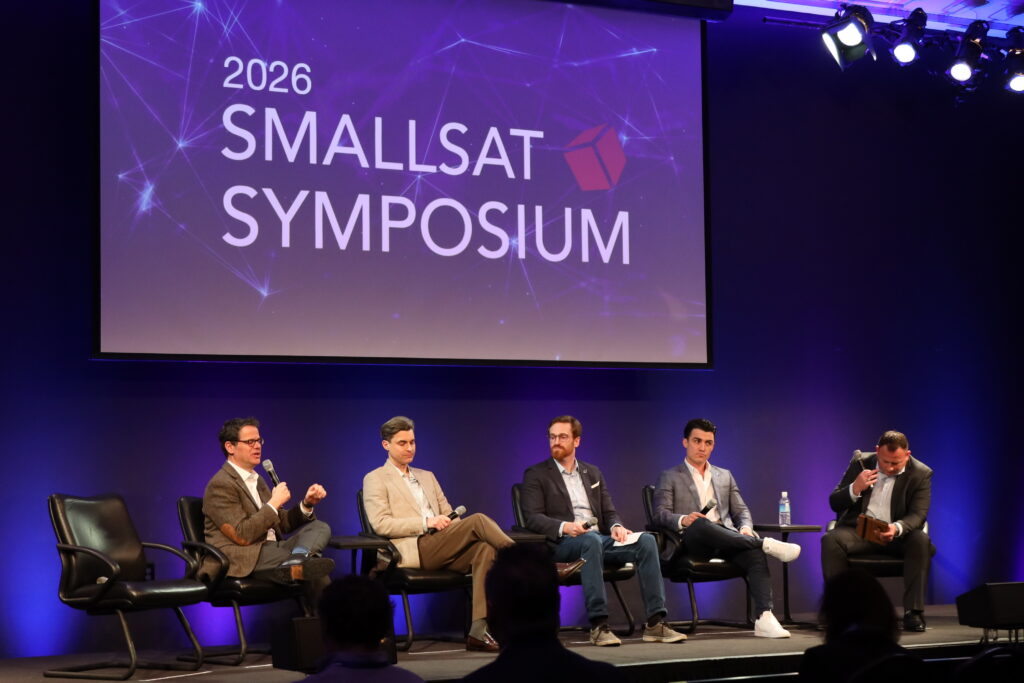
MOUNTAIN VIEW — If there was any doubt that the center of gravity in the commercial space sector has shifted from venture capital speculation to kinetic necessity, that doubt was shattered by the final session, Smallsats at the Tactical Edge – Hybrid ISR and Defense Integration. SmallSat Symposium this year was no longer about democratization for the sake of access. It is about survival, deterrence, and the industrialization of the kill chain.

The session’s panelists—representing the bleeding edge of propulsion, sensing, and compute—made one thing clear: Any distinction between a commercial satellite and a military asset has effectively evaporated.

The Department of War Reality

The rhetorical shift was immediate and jarring. Throughout the session, speakers abandoned the polite euphemism of defense in favor of a blunter reality.

“The Department of War? Doesn’t just roll off the tongue,” Impulse Space President Eric Romo remarked, acknowledging the strange bedfellows of Silicon Valley innovation and lethal force. Yet Romo admitted that the Pentagon is where the industry’s traction lies. This is not a reluctant partnership, but a necessary fusion driven by the Space Development Agency and its spiral development cycles, which have forced a terrifying pace on an industry used to moving slow.

The mandate is integration prior to crisis. Gone are the days when commercial space acted merely as a break-glass emergency backup for bandwidth surges. Commercial sensors are now weaving inextricably into the operational fabric before the first shot is fired.

Decision Superiority, Not Just Data

The panel dismantled the legacy obsession with resolution and bandwidth. In a contested environment, a pretty picture is useless if it arrives twenty minutes late. The new currency is latency.

Mark Gombo of HawkEye 360, a former Marine electronic warfare officer, cut through the technical noise. “I submit that it’s more about decision superiority,” Gombo argued. “It is the decision space to understand what’s going on.”

This aligns perfectly with the tactical realities seen in Ukraine and Gaza, where commercial signals are jammed and logistics chains are hunted by AI-enabled sensors. The objective is no longer to hoard terabytes of data, but to deliver a target track to a weapon system.

Jonny Dyer, CEO of Muon Space, reinforced this urgency, noting that whether tracking wildfires for first responders or missile trucks for the SDA, the requirement is identical: “We really have to rethink how we architect a lot of these core systems to enable what I think is really ultimately a latency driven requirement.”

The Friction of Space Compute

Despite the unity on mission, the panel fractured over the how. A sharp disagreement emerged regarding the role of edge computing and specifically whether to process data on the satellite or on the ground.

Jeff Janicik, CEO of Innoflight, championed the need for trusted, high-assurance on-orbit computing. To close the latency gap, he stipulated, the decision loop must move to space. “We all know that we can, if we can take the decision making and all the data collection and data fusion that is currently happening on the ground, bring it into the space,” Janicik claimed. The barrier is not the processor, he emphasized, but the trust required to let an AI make a decision that could trigger a kinetic effect.

Dyer was less convinced. In a moment of refreshing candor that typified the session, he pushed back against the industry obsession with putting data centers in orbit.

“I might be the outlier on this panel, but I just don’t think space compute’s that interesting of an idea,” Dyer said. “Ultimately, we shouldn’t care where processing is being done.”

Dyer’s skepticism highlights a critical engineering tension. Launching high-power GPUs into orbit creates massive thermal management headaches, a point reinforced by research on Andy Kwas’s work at Northrop Grumman. If the communications link is fat enough, processing on the ground is cheaper and easier. The satellites, Dyer argued, should look like a data center rack, but the software must be agnostic.

The Debris Euphemism

The most telling exchange occurred when moderator Andy Kwas raised the topic of debris removal and the recent DIU solicitation for de-orbiting unprepared satellites. In the polite society of civil space, this is an environmental discussion. In the context of a hybrid space war, it is a discussion about clearing lanes and neutralizing threats.

Romo stripped away the pretense entirely, asking the room, “Does anybody actually believe that that’s about space debris?”

The laughter was nervous but knowing. Janicik concurred, noting that right now the Department of War would be more focused on fighting through it.

The implication is heavy. Technologies developed for active debris removal are dual-use. If you can grab a dead satellite to de-orbit it, then you can grab a live adversary satellite to disable it. The industry is building ASAT capabilities under the guise of environmental stewardship, and everyone in the room knows it.

Are We Actually Ahead?

For all the bravado about American innovation, the panel ended on a note of strategic anxiety. When asked if the United States maintains superiority over peer adversaries, the answers were mixed.

Gombo was confident: “Absolutely.”

Romo, conversely, pointed to the lack of situational awareness in higher orbits, specifically Geostationary Orbit where critical national assets reside.

“I’m not so sure that—for battlefield awareness in the battlefield of GEO and probably MEO as well—that we actually are ahead,” Romo warned. He cited Chinese RPO-capable spacecraft performing inspection loops around U.S. assets with little public response.

The Bottom Line

The SmallSat Symposium has evolved. The New Space optimism of the past decade has hardened into a cold, pragmatic focus on national security. The validated gaps are lethal, the customers are wearing uniforms, and the companies that survive will not be the ones with the best PowerPoint slides. They will be the ones that can plug directly into a classified network and help a commander win a fight.

As Gombo bluntly advised the room: “If you bring me a capability that’s not on my gap list, you’re just bringing me another rock. And I don’t need any more rocks.”

Filed Under: Business & Finance, Missions & Constellations, SmallSat Tagged With: SmallSat Symposium 2026

The Thruster Reality Check: Why Boring is the New Stealth

February 12, 2026

By Abbey White, Staff Writer, SatNews

Dispatch from SmallSat Symposium. Coverage and analysis from across the conference, tracking the forces shaping the next phase of the SmallSat market.

MOUNTAIN VIEW — The brochure version of the future space domain is pumped with adrenaline. The military doctrine of Dynamic Space Operations envisions satellites dodging interceptors, inspecting unresponsive objects, and performing orbital acrobatics. Yet inside the SmallSat Symposium’s session on Smart Mobility: Propulsion and Maneuverability for Agile Smallsats, the vibe waxed less cinematic. Industry leaders building engines for this revolution fixate not on backflips but on the unsexy, grind-it-out reality of reliability and supply chains.

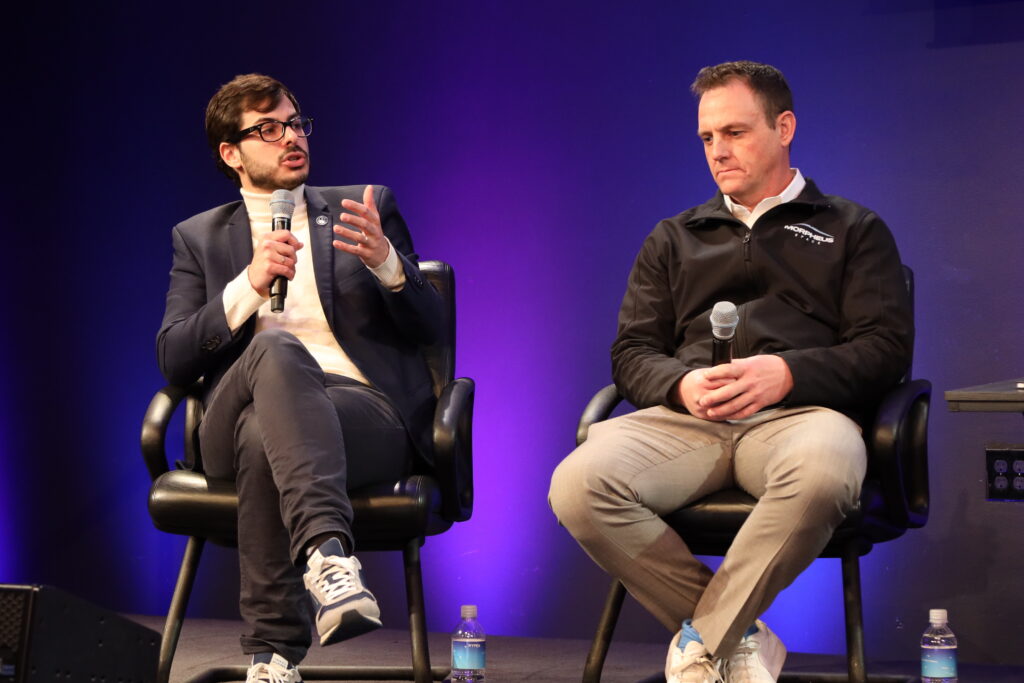
A widening gap separates military doctrine from commercial reality. The U.S. Space Force has pivoted to a philosophy where maneuver equals defense. They want assets that move without regret. The executives on stage (representing ThrustMe, Morpheus Space, ION-X, Neumann Space, and General Galactic) painted a picture of a far more conservative customer base.

The Agility Myth

Clement Cangelosi, Head of Sales at France’s ThrustMe, dismantled the room’s assumption that agility drives sales. While the industry assumes operators are desperate for rapid collision avoidance, data suggests otherwise.

“Of course they have collision avoidance and rapid maneuvers in their delta-V budget analysis. But it’s not what’s driving the discussion,” Cangelosi argued.

For the vast majority of commercial constellation operators, the priority is not sprinting capability but a certainty that the thruster will activate after three years of dormancy in a cold vacuum. The demand for proven heritage has become so intense that Cangelosi described his job as matchmaking between risk-averse clients and successful users.

“I have to be the Tinder of propulsion,” Cangelosi said. “I have to match my customers to tell them, look, we’ve achieved this with this customer. Let’s talk with the other customer that wants to do it.”

This conservatism creates a paradox. High-agility maneuver technology exists. The research brief circulating the conference highlights the shift from static orbits to Kinetic Constellations. However, the commercial market hesitates to pay for the capability unless it comes with a zero-failure guarantee.

The Supply Chain is the Weapon

Discussion quickly pivoted to the elephant in the room: sovereignty. Physics metrics like specific impulse and thrust density are increasingly secondary to the geopolitics of fuel sourcing. The research brief explicitly identifies reliance on critical minerals such as Gallium, Germanium, and Rare Earth Elements as a systemic risk given China’s dominance over these supply chains.

Panelists reflected this anxiety. The shift away from Xenon gas (which suffered price shocks following the invasion of Ukraine) to solid propellants like iodine and metal is not just technical, it is strategic.

Thomas Hiriart, CEO of ION-X, described a French defense mission called Toutatis involving a hunter-and-prey scenario. The mission utilizes a French launcher, French satellites, and French propulsion.

“If you want to be able to have ears and eyes in the sky very quickly, you need to be able to ship that infrastructure super-quickly,” Hiriart said. “Which means you need to own the supply chain.”

Jason Wallace, VP of Business Development at Neumann Space, views this fragmentation as an opportunity. His company uses solid metal propellants like Molybdenum and Magnesium that can be sourced from Australia or the Americas, effectively bypassing Chinese mineral choke points.

“We have opportunities in other regions of the world where we’re not a US company and they want sovereign capabilities, but don’t necessarily have the full supply chain within their own country,” Wallace said.

Cost vs. Physics

Halen Mattison, CEO of General Galactic, served as the session’s provocateur. A former SpaceX engineer, Mattison challenged the panel’s focus on reliability and suggested it often serves as a convenient excuse for stagnation and bloated budgets.

“The reliability narrative is the favorite of the primes,” Mattison suggested.

His argument cuts to the core of the sector’s financial struggle. Engineering teams naturally gravitate toward the highest performance metrics, while investors and procurement officers look at the bottom line.

“Propulsion is the coolest part of space—it’s the sexy part,” Mattison admitted. “But the folks who are going to make the decisions about what flies and what doesn’t, and who are looking at the budget, are probably going to make a decision based on cost.”

Mattison characterized the current state of chemical propulsion (dominated by toxic hydrazine and expensive new alternatives) as “sad.” His company bets on water electrolysis to break the cost curve, leveraging the solar system’s most abundant resource to enable logistics over mere station-keeping.

The Regulatory Hammer

Hanging over the technical debate is the Federal Communications Commission’s new 5-Year Rule, which mandates that satellites deorbit within five years of mission completion. This regulation has effectively turned propulsion from a luxury into a legal requirement for any satellite operating above 400 kilometers.

While the panel generally welcomed the rule as a market expander, Hiriart offered a sharp warning regarding implementation. If regulators demand immediate perfection, they risk suffocating the very startups trying to solve the problem.

“If you’re saying from one day to the next every satellite operator needs to be able to deorbit within five years with a reliability of 99.9%, you kill all new EP suppliers because none of us today can demonstrate that type of reliability,” Hiriart said.

The Kinetic Constellation

The industry is caught in transition. The technology for the Kinetic Constellation is here. Iodine systems from ThrustMe are industrialized, metal drives from Neumann are flying, and water systems from General Galactic are on the horizon. The military doctrine of Dynamic Space Operations demands such mobility.

However, the commercial reality on the ground in Mountain View remains pragmatic. The winners in the next three years will not necessarily be the thrusters with the highest specific impulse. They will be the ones manufactured at scale, shipped without hazardous material waivers, and trusted to fire when the collision warning turns red.

As Mattison noted, the industry must move away from the mindset where a mission costs ten times more than anticipated.

Agility is the future. But until the supply chain is secure and reliability is absolute, the revolution will remain on the launchpad.

Filed Under: Launch, Launch Providers Tagged With: SmallSat Symposium 2026

Balance Sheets Now Matter More Than Rockets

February 12, 2026

By Abbey White, Staff Writer, SatNews

Dispatch from SmallSat Symposium. Coverage and analysis from across the conference, tracking the forces shaping the next phase of the SmallSat market.

MOUNTAIN VIEW — The visionaries pitching Mars colonies have largely left the building. In their place sit investment bankers, project finance lawyers, and strategic investors who are currently rewiring the architecture of the $613 billion space economy. At this year’s SmallSat Symposium, the speculative exuberance of the SPAC (special-purpose acquisition company) boom has vanished, replaced by a mood of disciplined pragmatism. The Space Capital Markets session delivered a painful clarity to the room: the novelty of access to orbit is commoditized. Value now relies on applying traditional financial rigor to orbital infrastructure. 

Preston Dunlap, former Chief Architect of the U.S. Space Force and session moderator, immediately addressed the massive valuation gap hanging over the industry. He pointed to the potential SpANGO era, a convergence of Space, AI, and Big Tech, which suggests space is finally joining the ranks of terrestrial heavyweights like NVIDIA and Meta. The data supports this view. The global space economy entered 2026 with a valuation of $613 billion, driven largely by a commercial sector that has finally achieved escape velocity from pure government dependence.

The End of the Napkin Round

The era of raising $50 million on a slide deck is over. Mike Collett, Managing Partner at Promus Ventures, offered a sobering reality check for the founders in attendance. The backlog of companies waiting to go public is long, he noted, but private markets continue to fund them because public exchanges demand legitimate earnings rather than mere projections. Collett questioned “the ability of the private capital market to continue funding companies until the cows come home.  . . . There’s just zero reason for many companies to actually go out.”

Investors now demand traction and substantial scale. Collett elaborated on the sheer duration required to see returns in this sector. “It’s a very long bus ride,” Collett said. “You better like the people on the bus and you better bring some sandwiches.”

This patience is becoming a prerequisite because the market is bifurcating into a K-shaped recovery. The Upper K consists of midstream and downstream infrastructure firms, specifically those selling data or orbital services, whose valuations are stabilizing. Conversely, the Lower K is populated by launch startups and early-stage hardware companies without recurring revenue. Many of these firms face a Valley of Death as capital dries up for unproven models.

The SpaceX Effect: A Rising Tide?

The specter of a massive SpaceX valuation loomed large over the discussion. Dunlap noted rumors of a $1.5 trillion valuation, a figure that positions the company as a top-tier global asset. Yet the panelists largely rejected the idea that SpaceX sucks the oxygen out of the room. Instead, they argued, its established value validates the entire asset class.

Joe Dews, Managing Director at Craig-Hallum, contended that the narrative has fundamentally shifted from slow-moving aerospace to rapid tech disruption. “We’re now talking about commercial space, more about disruptors, more about industries changing, rapidly driven by innovation,” Dews said. He added that a huge universe of public investors currently embraces that sort of rapid change.

Robert Benton, General Counsel for Space Leasing International (SLI), was even more specific, pinpointing the exact driver of this excitement. “It doesn’t feel like it’s really SpaceX that’s doing this. It’s Starlink,” Benton said. Its mega-constellation model’s success has proven that space assets can generate utility-like returns, lifting confidence across the board.

Financial Engineering Enters Orbit

Perhaps the most significant development discussed was not a new propulsion system, but a new financial instrument: the orbital lease. SLI is pioneering an aviation-style leasing model for satellites that allows operators to convert massive upfront Capital Expenditure into manageable Operating Expenditure.

Benton described SLI’s role not as a traditional lender but a partner that buys the asset and leases it back. “We have no real interest in taking a position on one or the other,” Benton explained. “We like to spread our risk.” This model allows companies to retain equity for R&D rather than sinking it into hardware. Benton cited a deal with RBC Signals where SLI purchased ground stations and leased them back to the operator: “It became a really good financial option for RBC.” 

The Strategic Safety Net

Undergirding this commercial activity is a renewed and aggressive posture from the U.S. government. The research brief highlights a Capital Cold War between the U.S. and China, noting that Chinese state-guided investment in space tripled in 2024 while U.S. startup investment contracted. To counter this, mechanisms like the Office of Strategic Capital (OSC) are deploying loan guarantees to bridge the gap.

Sara Jones, Investor at In-Q-Tel, emphasized that this government backing is not just about money; it is about survival during the long development cycles of deep tech. “Patient capital is essential for this industry,” Jones said. She stressed that venture capital timelines often do not align with physics: “It is absolutely essential that there are different types of patient capital . . . in order to get the company into a timeframe where they really start to look attractive.”

Alexis Sáinz, Partner at Hogan Lovells, pointed to the MP Materials transaction, a critical minerals deal involving the OSC, as a blueprint for space. “If you look at the ones where there’s an equity component and you look at the price, the share price where it’s gone since that government investment happened . . . up,” Sáinz stated. The message is clear: Government backing is now a signal of stability that attracts private equity rather than crowding it out.

The Wild West Evolution

The industry has moved beyond the Wild West phase, evolving into a zoned, regulated, and capitalized industrial park. Success in 2026 will not be determined solely by who builds the best rocket engine. Rather, it will depend on who can best navigate this new financial stack by combining venture capital for innovation, private equity for scaling, and asset-backed leasing for infrastructure.

Differentiation in 2026 comes from the balance sheet as much as the clean room. As Mike Collett summarized, the future is bright, but the timeline is long. “The future is very, very good, but it’s going to require patience.”

Filed Under: Business & Finance, Launch Providers Tagged With: SmallSat Symposium 2026

70,000 Satellites, One Big Bottleneck: The Industry Wakes Up to the Data Trap

February 12, 2026

By Abbey White, Staff Writer, SatNews

Dispatch from SmallSat Symposium. Coverage and analysis from across the conference, tracking the forces shaping the next phase of the SmallSat market.

MOUNTAIN VIEW. For the last decade, mass-to-orbit reigned as the primary success metric. The narrative was deceptively simple: get the birds up, and the money will follow. But at the SmallSat Symposium session Space Data Economy: Bottlenecks and Future, the panel defined a shift from celebration to a stark realization of infrastructure failure. The industry successfully built a highway to space but forgot to build the off-ramps.

Novaspace Partner Nathan De Ruiter presented staggering figures. Opening the floor with an exclusive forecast, he predicted that 70,000 small satellites launching over the next decade will represent an investment of roughly $134 billion. Yet the mechanism for getting those satellites’ data back to Earth remains archaic, fragmented, and dangerously slow. We have entered the era of the Data Trap, where terabytes of potential insight perish in orbit because the physical pipe to the ground is too narrow.

The Plumbing Crisis

The disconnect between orbital capability and ground reality is no longer a technical nuisance but rather an existential threat to Earth Observation business models. Ali Younis, VP of Sales at laser communication manufacturer Mynaric, did not mince words regarding the current state of RF downlink scheduling.

“Imagine you wanting to give me a call from your phone to my phone,” Younis told the audience. “You have to submit a request to AT&T telling them, ‘I want to pick this 5G tower at this time in order to call Ali.’ Come on, what age are we in?”

This manual store-and-forward latency is unacceptable for high-value use cases like wildfire monitoring or battlefield awareness. The consensus in the room became clear: the store-and-forward model is dead; the new mandate is Time-to-Insight.

Warpspace, a Japanese startup, is attempting to bypass this bottleneck by placing optical relay satellites in Medium Earth Orbit. This architecture allows Low Earth Orbit satellites to shoot data up via laser rather than waiting to fly over a ground station. Hirokazu Mori, Warpspace’s US CEO, emphasized the urgency.

“Otherwise, it doesn’t make sense just moving data around just in space,” Mori argued.

The Hardware Reality Check

Optical communication, or lasers, promises gigabit speeds as a solution, but the manufacturing reality has been brutal. Mynaric, represented by Younis, has been a bellwether for the sector’s volatility. The company faced a severe liquidity crunch in 2024 due to production yield issues, leading to massive restructuring and a 2025 delisting.

Despite the financial turmoil described in research briefs, Younis projected confidence on stage. He noted that the Space Development Agency has successfully forced a standardization of the technology.

“The SDA standard that most OCT providers are building towards or making sure that they’re compatible with provides cost efficiencies,” Younis stated.

Yet, skepticism remains about when this hardware will truly become affordable. John Malsbury, CEO of AnySignal, offered the day’s most grounded economic benchmark by rejecting the notion that space hardware must remain bespoke and expensive.

“I believe in the world where a satellite bus and all of its content should be about the price of a Kia Soul,” Malsbury declared.

Malsbury’s radio-frequency company bets on a hybrid approach, arguing that while optical is the future of heavy data haulage, software-defined radio remains the backbone of command and control. His stance serves as a necessary counterweight to the laser hype. Physics remains undefeated. RF (Radio Frequency) penetrates clouds; lasers do not. Consequently, future architectures will likely see high-value assets carrying both: Mynaric or Warpspace terminals for the profit (imagery), and AnySignal radios for the asset (telemetry).

The Defense Lifeline

Commercial viability remains a distant target for many hardware providers. The Reality Check lens reveals that without the Department of Defense, many of these companies would not exist. The narrative of a booming commercial marketplace is partially a facade covering a sector that is increasingly becoming a government contractor ecosystem.

When pressed by De Ruiter on revenue splits, the answers were telling.

“Government takes up about 70 to 80% of our revenues,” Younis admitted.

This reliance on Sovereign EO drives a wedge in the market. Governments are no longer satisfied with just buying pixels; they demand sovereign capabilities with infrastructure that ensures prioritized and uncensorable access to data. This shift forces companies like SkyWatch and AnySignal to navigate a fractured federation of sovereign clouds rather than a single global market.

The Value Gap

The final bottleneck is less technical than economic. The industry generates petabytes of data, but customers do not want data—they want answers. David Proulx, Chief Product Officer at SkyWatch, highlighted the current market’s immaturity: “There’s a greater demand for data than those providers can provide,” Proulx noted, pointing out the scarcity of reliable, high-resolution options. “We are still trying to sell raw ingredients to people who want a cooked meal.”

Research underscores this divide. While the raw data market grows at a modest 6.2%, the value-added services market is projected to explode. Companies like GHGSat have cracked this code by decoupling revenue from pixels and tying it to regulatory compliance and methane abatement. They are not selling images; they are selling the ability for an oil major to avoid a fine.

The Bottleneck

The sheer volume of incoming satellites (70,000 of them) will crush any operator who has not solved the downlink and processing equation. The winners will not be the ones with the best resolution. They will be the ones who can move a gigabit from orbit to a decision-maker’s screen in under a minute.

As Malsbury summarized, “Data stuck in space is meaningless.” The bottleneck is no longer gravity. It is connectivity.

Filed Under: Business & Finance, Satellite Communications, Services & Applications Tagged With: SmallSat Symposium 2026

Software Defines the New Front Lines of Space Defense

February 12, 2026

By Abbey White, Staff Writer, SatNews

Dispatch from SmallSat Symposium. Coverage and analysis from across the conference, tracking the forces shaping the next phase of the SmallSat market.

MOUNTAIN VIEW. For decades the space industry measured ground segment power in rack units and heavy copper cabling. That model was effectively retired here at the SmallSat Symposium. Instead of bigger antennas or faster rockets, discussion on the floor focuses on the convergence of Silicon Valley software agility with modern defense’s strategic requirements.

Industry leaders, evaluating the traditional architecture of satellite operation at SmallSat’s Space Virtualization, AI, and Future panel, presented a challenge for legacy vendors. The U.S. military and intelligence communities are moving away from hardware in order to prioritize applications with abilities to download a ground station to a laptop in a forward operating base, to process targeting data in orbit, and to execute solutions before an adversary detects observation.

The End of the Pizza Box

Nicole Robinson, President of Gilat DataPath, clearly articulated this shift. Her company, deeply entrenched in the defense sector, sees uniformed customers moving away from the proprietary hardware that once defined the industry’s physical infrastructure.

Channeling feedback from her defense clients, Robinson said, “We don’t need a whole bunch of pizza boxes anymore. We’re happy to pay you for your waveform just as much as we were happy to pay you for your pizza box.”

This represents a paradigm shift where the modem becomes a piece of software running on a generic server. Rather than a matter of convenience, the Department of Defense finds this an operational necessity. A physical ground station makes a fixed target. A virtualized ground station can provide resiliency instantly by being spun up in a cloud container on the other side of the planet. In a contested environment, Robinson noted, operators cannot be “beholden to one path of communication, one orbit, one frequency.”

The Battle for the OODA Loop: Cloud vs. Edge

The panel highlighted a tactical distinction regarding where data processing should occur. On one side sits the centralized power of hyperscale cloud providers. On the other lies the distinct physics of the tactical edge.

Doug Hairfield, Senior GenAI Solutions Architect at AWS, discussed the scale of terrestrial cloud computing. The “impatience of humans” generates a need for democratization, where “no longer do you have to be an aerospace engineer to be able to provide value.” In his aggregative vision, large datasets are pulled down to Earth to be processed by Large Language Models and generative AI.

Dennis Gatens, President of LEOcloud, challenged that vision with the constraints of a defense scenario, where the latency in sending data to a centralized cloud, along with the cost of data egress, creates a potential liability: “It enables the insight versus the raw data to be delivered from space to Earth.”

Gatens instead advocates for the Space Edge. His firm, now part of Voyager Technologies, has deployed data center infrastructure to the International Space Station with a clear strategy. Process the data in orbit. Instead of sending the image of the ocean, send the ship’s coordinates. Such an architecture bypasses the egress costs of the cloud, tightens the OODA (Observe, Orient, Decide, Act) loop, and gains fundamental advantages in “security, latency and transport.”

The Autonomous Kill Chain

Fully autonomous systems made a significant part of the conversation. Dr. Owen Brown of Scientific Systems (SSCI) steered discussion to “tip and cue” architectures. In this scenario, a satellite detects an object of interest and, without human intervention, autonomously tasks another asset to track it.

Such a process establishes a technical foundation for an autonomous kill chain, which Robinson described as working in practice by fusing different data types to validate targets instantly.

“One SAR collection in black and white is not really going to tell you an awful lot,” Robinson explained. “But the fusion of a SAR change detection algorithm produces an insight that says there are vehicles in this particular location.”

The speed of that insight is its primary value. The system identifies a confirmed set of vehicles and classifies the tank type, allowing commanders to make decisions based on that data.

The Garbage-In Risk

However, the move toward automated defense systems significantly raises a risk profile. Lucy Hoag, CEO of Violet Labs, provided a voice of caution, noting that the industry’s focus on speed must be balanced with quality verification. Software tools used to build these systems are often outdated, creating a gap between AI capabilities and engineering realities.

“The slow pace that we’ve allowed ourselves to deliver space systems is not just untenable,” Hoag stated. “It’s egregious.”

Hoag’s concern addresses the core AI dilemma. Flaws in underlying data may lead an autonomous system not just to act faster but to make a mistake faster. If an AI model misidentifying a rock as a tank in a demonstration is a technical issue, in an operational theater it is a critical failure.

The “Quindar” Signal

The days of bent pipe connectivity are fading. The new space architecture is a global, orchestrated system defined by software.

Companies like Quindar are automating control rooms. Co-founder Sunny Bhagavathula noted that operators are “not hiring more people” but expecting software to handle the scale. The infrastructure becomes invisible as it moves into code and containers. While the hardware footprint decreases, the stakes remain high. Beyond selling bandwidth, the industry is now selling the speed-of-decision advantage.

Filed Under: Business & Finance, Software Automation & Ground Systems, Space Systems Software Engineering Tagged With: SmallSat Symposium 2026

SES Executive Confirms End of the 15-Year Satellite Era

February 12, 2026

By Abbey White, Staff Writer, SatNews

Dispatch from SmallSat Symposium. Coverage and analysis from across the conference, tracking the forces shaping the next phase of the SmallSat market.

MOUNTAIN VIEW. For decades, the geostationary arc located 35,786 kilometers above the equator served as the undisputed domain of massive, billion-dollar platforms designed to generate revenue for twenty years. That economic certainty officially evaporated, however, during the SmallSat Symposium session titled The Future of GEO Satellites. (GEO = Geosynchronous Equatorial Orbit)

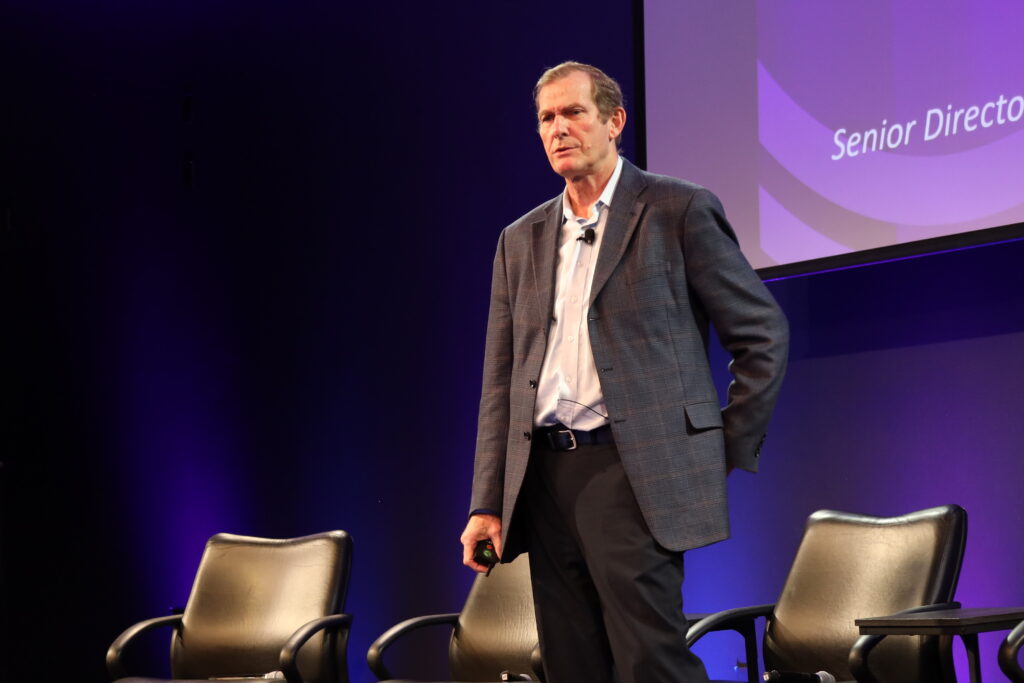
Taking the stage, Dr. Bryan Benedict, Senior Director of Innovation at SES Space & Defense, dismantled rather than defended the legacy model. He described the merger between satellite giants SES and Intelsat that created a fleet of over 100 operational spacecraft not as a strategic power play but as a tactic necessary for survival.

Benedict spoke bluntly about the regulatory shifts enabling this consolidation. While antitrust laws would have blocked such a merger a decade ago, regulators changed their stance due to a single existential threat: the commoditization of bandwidth by Low Earth Orbit (LEO) constellations like Starlink: “Our competition is not other GEO operators; it’s proliferated LEO.”

This admission marks a sharp turning point for the industry. The massive battlestar satellites (6,000-kilogram behemoths designed to amortize capital costs over two decades) have become financial liabilities. Rapidly falling bandwidth prices have shattered the spreadsheet logic that underpinned the modern telecommunications industry.

“Likely, the majority of those satellites will not be replaced,” Benedict told the hushed room, “because the business case for them just no longer closes,”.

The Collapse of the 15-Year ROI

The mood in Mountain View reflects a state of forced adaptation. While the halls bustle with startups pitching agility, a reality check came down from the top of the food chain. The mathematics of geostationary orbit are fundamentally broken. Operators can neither predict demand fifteen years out, nor justify locking hundreds of millions of dollars into static hardware.

Benedict detailed the collapse of the return on investment. Under the heritage model, a satellite paid for itself in five to seven years, generating pure profit for the subsequent decade. That window has slammed shut.

“Now you might get your money back at the end of 15 years, and that’s the life of the satellite,” Benedict explained. “So that business case, when you take into account the risk involved, just does not work.”

Financial toxicity has subsequently emptied manufacturing pipelines. Industry veterans accustomed to busy clean rooms now see a significant slowdown. “We’ve been to the spacecraft high bays and they are packed full of commercial GEOs being built?” Benedict asked, then answered, “No, you’re completely wrong. The high bays are not packed with GEOs anymore.”

The MicroGEO Pivot and the Reliability Trap

The MicroGEO revolution now fills the vacuum left by legacy giants. This new class of sub-1,000-kilogram satellites promises to lower the barrier to entry for GEO and enable rapid technology refreshes, mirroring what CubeSats achieved for LEO.

The concept prioritizes fleet redundancy over internal redundancy. Rather than relying on a single exquisite asset with triple-redundant systems, operators launch swarms of cheaper, single-string satellites. If one fails, the network survives.

“You have not internal redundancy but fleet redundancy,” Benedict said.

This shift responds to a practical necessity, not a theoretical exercise. The U.S. Department of Defense has pivoted to a proliferated warfighting architecture, injecting billions into the sector through the $151 billion SHIELD contract vehicle. The Pentagon, viewing large satellites as fat targets, now demands distributed resilience.

However, the transition is fraught with peril. The MicroGEO sector is currently reeling from high-profile failures, including, earlier this year, the loss of Astranis’s UtilitySat, which was stranded in a useless transfer orbit following a propulsion failure. Reliability remains the unspoken ghost in the machine. Benedict, a chemical engineer by training, hinted at the supply chain fragility accompanying this shift.

“Things that we used to call COTS (Commercial Off-The-Shelf), they’re not on the shelf anymore because they were being built for GEO spacecraft,” Benedict noted.

The LEO Threat Was Underestimated

Perhaps the session’s most sobering moment was Benedict’s recollection of the industry’s hubris regarding Starlink and other mega-constellations. Legacy operators spent years convincing themselves that LEO was a niche product that would not cannibalize their core business.

“We were assured by the proliferated LEO companies, ‘This is not a threat for you guys. This is an entirely new business. You guys don’t have to worry,'” Benedict recounted. “Yeah, right.”

That complacency cost the sector dearly. Old Space operators are now scrambling to integrate multi-orbit capabilities, linking GEO, MEO, and LEO into a single network. The user, particularly the military warfighter, has stopped caring about orbital mechanics.

“The warfighter just wants to know they can get connected and they don’t care how—they just want to be connected,” Benedict said.

A Fractured Horizon

The conclusion from here is clear: the geostationary belt is not being abandoned, but gentrified. High-rent, monolithic tenants are moving out, replaced by a higher density of smaller, more agile structures. This is no longer a real estate game of location, location, location. It is a technology race defined by refresh cycles and integration.

Dr. Benedict’s address served as a grim obituary for the status quo. While the Golden Dome of missile defense may provide a lifeline for small satellite manufacturers, the days of easy money for the commercial sector are gone. The high bays are empty, the order books are thin, and the only thing proliferating is risk.

As Benedict stated regarding the sector’s future, “It sounds like the word of God coming from up above.” The commandment is simple: Evolve or de-orbit.

Filed Under: Business & Finance, Satellite Communications, Services & Applications Tagged With: SmallSat Symposium 2026

Compliance Becomes the New Gatekeeper for Space Startups

February 11, 2026

By Abbey White, Staff Writer, SatNews

Dispatch from SmallSat Symposium. Coverage and analysis from across the conference, tracking the forces shaping the next phase of the SmallSat market.

MOUNTAIN VIEW. The SmallSat Symposium traditionally showcases hardware and orbital mechanics, but this year a different theme emerged. As the commercial space sector deepens ties with the Department of Defense, the focus is shifting from pure innovation to operational maturity.

During the session Orbiting Compliance: Navigating GovCon Risks in the Space Economy, industry experts outlined a new reality. The startup ethos of rapid experimentation is transitioning into a phase of rigorous documentation. Regulatory adherence is no longer a secondary concern; it has become a primary requirement for entering the federal market.

The Cost of Entry

The central challenge is implementation of the Cybersecurity Maturity Model Certification (CMMC) 2.0, which establishes new cybersecurity standards for defense contractors. For early-stage companies, the financial commitment is significant. Panelists estimated that achieving CMMC Level 2 compliance requires an investment between $100,000 and $200,000, presenting a strategic choice for engineering-focused firms.

Tucker Ward, Head of Finance at Starfish Space, shared how his company navigated this hurdle after securing a $52.5 million contract with the Space Force. Rather than applying blanket compliance across the entire organization, Starfish adopted a targeted approach by building a specific digital enclave for Controlled Unclassified Information.

“If we had to do CMMC across the entire company, that would just slow things to a halt,” Ward explained. By isolating the compliant infrastructure, Starfish protects its agility, allowing the majority of technical work to continue unimpeded. “Starfish is unapologetically innovation-first and engineering-first. Whenever we have a new compliance requirement, our first way of approaching that is, how do we make sure this doesn’t get in the way of the engineering?”

Converging Oversight

Beyond cybersecurity, the panel highlighted a structural change in government audits. Alex Mikhelson, a director at Baker Tilly, pointed to the increasing overlap between the Defense Contract Audit Agency (DCAA) and the Defense Contract Management Agency (DCMA). Previously distinct in their focus, financial auditors are now examining government property records to ensure alignment with the internal audit readiness goals of the DoD.

This convergence impacts companies developing dual-use technologies. Startups must meticulously track government-funded hardware to distinguish it from commercial assets, as failure to separate these inventory streams can lead to business system disapprovals or payment withholds. “Surprises are for birthday parties,” Mikhelson advised the room. “Nobody wants surprises.”

Supply Chain Transparency

The pressure for compliance extends down to the supply chain. Prime contractors are contractually obligated to enforce these standards on their subcontractors. Joshua Madrigal, Vice President at Millennium Space Systems, explained that while Millennium operates with a focus on speed, they require clear visibility into supplier operations to manage risk.

“Transparency and honesty need to be there,” Madrigal emphasized. “It’s, ‘Hey, we’re probably not here today, but these are the steps and here’s our roadmap of getting there.'”

This scrutiny includes component origins, as sourcing parts from restricted jurisdictions can jeopardize entire programs. Ward cited an instance where a potential supplier revealed a component originated in China. “It turns out this little component part of it was made in China. And this is for a DoD satellite program, so that’s a problem,” Ward noted. “Having to turn around and tell the DoD that there’s some Chinese components on here is a very bad day.”

Strategic Legal Frameworks

Ryan Kelley from Greenberg Traurig addressed the legal complexities facing the sector, observing that companies often struggle to identify which regulations apply to their specific growth stage. Kelley cautioned against over-compliance, arguing that seed-stage companies do not need to implement the same controls as established defense primes.

“You don’t need to spend twenty grand to classify your five products when you’re a seed-stage company. That would be a waste,” Kelley said. He also highlighted the importance of tax planning, specifically regarding Qualified Small Business Stock. Errors in how founder shares are redeemed can inadvertently disqualify a company from significant tax benefits. Kelley warned, “Redemption should be a four-letter word for a lot of people.”

The Industry Outlook

The distinction between commercial innovation and government requirements is narrowing, and companies are finding that robust back-office systems are becoming as critical as their orbital hardware. Investors and partners are increasingly looking for audit-ready fundamentals. As the sector grows, the ability to navigate this regulatory landscape will likely distinguish long-term players from the rest of the field. Compliance is no longer just a hurdle; it is a necessary component of scaling a space business.

Filed Under: Export Controls & Compliance, Missile Warning & Defense, Missions & Constellations, Startups & NewSpace Business Tagged With: SmallSat Symposium 2026

The FCC Is Converting Space Regulation Into an Assembly Line

February 11, 2026

By Abbey White, Staff Writer, SatNews

Dispatch from SmallSat Symposium. Coverage and analysis from across the conference, tracking the forces shaping the next phase of the SmallSat market.

MOUNTAIN VIEW. Administrative throughput has replaced launch cost as the defining metric of the commercial space industry. With operators deploying constellations in the thousands, the Federal Communications Commission deems the artisanal licensing model obsolete.

Dr. Jay Schwarz, Chief of the FCC Space Bureau, delivered a direct message to the industry during the Navigating Global Space Regulations session this afternoon. The Bureau is pivoting its operational philosophy from adjudication to mass production.

Data dictates this shift. Historical capacity cannot match the current volume of activity.

“The number of licenses, or license requests, that have come into the Space Bureau has increased by over 200%,” Schwarz stated.

Such a surge mandates a structural redesign of orbital management. A system engineered for a few television satellites fails to process thousands of low-Earth orbit broadband nodes efficiently. Schwarz argued that the regulator must adopt the operational cadence of a factory.

Standardization Over Negotiation

The Presumed Acceptable Framework anchors this new approach. Moving away from bespoke analysis, the FCC is establishing rigid technical envelopes. The agency intends to approve applications that fit with minimal friction within pre-set parameters regarding power levels, orbital debris, and spectrum usage.

“If you’re proposing something that falls squarely within the rules for our application, we want you to know that you’re going to get the thumbs up,” Schwarz explained.

Certainty drives this mechanism. Operators require the assurance that a standard application yields a standard result. This predictability eliminates the guesswork that frequently stalls financing and deployment. Effectively, the FCC welcomes engineering creativity while demanding compliance standardization.

Flexibility extends to post-licensing operations. The Bureau is removing requirements for operators to file requests regarding minor operational adjustments.

“You don’t need to be asking permission for every little change,” Schwarz said. “That’s what we’re trying to achieve.”

Infrastructure for the Industrial Revolution

Schwarz positioned this regulatory modernization as a vital element of the Space Industrial Revolution. Comparing the initiative to ancient infrastructure projects, he noted that the regulator’s role is to pave the road rather than direct traffic.

“I think of what we are trying to do is enable builders to build the Roman Road of today,” Schwarz noted. “It enabled trade across the Roman Empire, but also rapid deployment of troops across the empire.”

The logic remains straightforward. Both national security and economic prosperity depend on deployment velocity. The United States risks losing space leadership if domestic operators languish in a queue.

The International Bottleneck

Domestic streamlining faces limits at international borders. The session underscored the disconnect between American efficiency and congestion at the International Telecommunication Union.

A system strained by speculative filings is detailed in the Research Brief accompanying the session. Nations currently register hundreds of thousands of theoretical assets in order to claim spectrum priority. Filings from Rwanda and China alone dwarf the total number of objects currently in orbit.

Government officials are actively preparing for the World Radio Conference in 2027 to address these coordination issues.

“80% of the items on WRC-27 are for space,” Schwarz said.

Growth as Policy

The session concluded with a defense of the economic value of space activity. Critics have recently cited environmental concerns regarding orbital density and launch cadence. Schwarz dismissed the idea that the industry must contract to mitigate these risks.

“We wholeheartedly reject degrowthist mindsets which say there’s something bad about it,” Schwarz asserted. “We want more space activity for the good of society.”

The FCC position is evident. The agency is retrofitting internal machinery to manage high volume, and operators must standardize filings to match this cadence. The era of negotiation has ended. The regulatory assembly line has begun.

Filed Under: Government & Regulation, Spectrum & Licensing Tagged With: SmallSat Symposium 2026

SmallSat Launch Prices Rise as Competitors Stall on the Pad

February 11, 2026

By Abbey White, Staff Writer, SatNews

Dispatch from SmallSat Symposium. Coverage and analysis from across the conference, tracking the forces shaping the next phase of the SmallSat market.

MOUNTAIN VIEW. The era of cheap, plentiful, and diverse access to space was supposed to be here by now. Instead, the industry arrived at the 2026 SmallSat Symposium only to find itself trapped in a bottleneck of its own making.

During the Small Payloads, Large Upmass session, the polite veneer of industry camaraderie barely concealed the tension in the room. The narrative of a vibrant, multi-provider marketplace has collapsed. In its place sits a single, dominant provider, SpaceX, flanked by a long line of customers paying premium rates to stand in line. While panelists from Rocket Lab, Stoke Space, and European challengers like Isar Aerospace and PLD Space offered visions of a diverse future, the audience is living in a present defined by scarcity.

The Aggregator is the New Gatekeeper

The most telling dynamic onstage was not between the rocket builders but rather centered on the empty chair left by the neutral broker. With the dissolution of Spaceflight Inc.’s independent brokerage model, Exolaunch has emerged as the primary funnel for the industry’s volume.

Kier Fortier, Chief Revenue Officer at Exolaunch, did not shy away from the congestion defining the current market. The days of simply booking a slot and flying are over; operators must now plan for delays as a fundamental business condition.

Fortier stated, “I do think rebooking now is just the baseline expectation to salvage your launch budget.”

This admission signals a profound shift. Launch is no longer a commodity you buy, but a probability you manage. The consolidation of demand onto SpaceX Transporter missions has created waitlists. Fortier noted that despite the high flight rates, “There are folks eager to get up on orbit, and there is some scarcity there.”

The Paper Rocket Problem

This scarcity stems from the simple fact that the challengers are late. Rocket Lab’s Neutron was originally promised for 2024, yet it is now targeting mid-to-late 2026. Brian Rogers, Rocket Lab’s Vice President of Global Launch Services, framed this delay as a necessary hurdle of scaling.

Rogers argued, “Building your first rocket is ridiculously hard. Building your next 10 at rate is actually way harder.”

While Rogers is correct, the market is unforgiving. Every month Neutron remains on the ground is a month where mega-constellations sign long-term contracts with SpaceX’s Falcon 9. The session moderator, Curt Blake, former CEO of Spaceflight, pressed the panel on the risks of a monopoly trap.

Devon Papandrew, VP of Business Development at Stoke Space, addressed the monopoly question head-on. He dismissed the idea that SpaceX’s dominance is accidental or unfair, attributing it instead to technical superiority that others failed to match in time.

“Why is SpaceX a monopoly today?” Papandrew asked, then answered, “They created a step change in capability that unlocked higher cadence and lower cost.”

Stoke Space is betting $510 million that partial reusability is a dead end. Papandrew contended that the only way to break the current pricing floor, now rising toward $6,500/kg, is full reusability.

“If you look what SpaceX has done with Falcon, it’s amazing,” Papandrew said. “But if you ask them what constrains their flight rate, it’s production of the upper stage.”

The Sovereign Illusion

For the European representatives, the challenge is existential. Isar Aerospace, PLD Space, and Avio are fighting for a slice of the market that isn’t captive to U.S. dominance. Yet their value proposition relies heavily on the sovereignty premium—the idea that European institutions will pay more to fly European.

Francesco Sgarbossa, Sales Director for Avio, was refreshingly blunt about the limitations of European cadence compared to the American juggernaut.

“We are aiming at six, which sounds like a very low number when you think about it when you see SpaceX launching 160 times,” Sgarbossa admitted. “But even going from four to six is a 50% increase and that requires huge investments.”

The Ancient Game of Launch Chicken

The friction between satellite readiness and rocket availability remains the industry’s favorite scapegoat. Brian Rogers described the constant shuffling of manifests as a necessary evil.

“We’re no strangers to the ancient game of launch chicken,” Rogers said. “Spacecraft can be late. And that can be a problem when you’re trying to plan a manifest.”

But in 2026, the chicken has come home to roost. The delays are no longer just about spacecraft. The launch vehicles themselves are the bottleneck. The regulatory environment has tightened, and the FAA licensing backlog is real. The flexible slotting discussed by the panel is merely a band-aid for a lack of capacity.

“You got to launch”

The dream of a dozen thriving small launch providers competing on price has faded. The reality is a barbell market: a massive, efficient monopoly on one end, and a collection of hopeful, delayed challengers on the other.

Until Neutron flies, Stoke reaches orbit, and the European launchers prove they can hit a cadence higher than single digits, the SmallSat customer has no real leverage. They will pay the $6,500/kg, they will sign the multi-launch agreements, and they will thank Exolaunch for the privilege of a slot.

As the session concluded, the applause felt less like a celebration of innovation and more like relief that the status quo, however expensive, is at least a known and predictable factor. Curt Blake ended the panel by asking about the challenge to survive. Brian Rogers offered the only advice that matters in an industry choked by promises.

“You got to launch.”

Filed Under: Missions & Constellations, SmallSat, Spacecraft & Payload Technology Tagged With: SmallSat Symposium 2026

The Dumb Pipe Is Dead: Why Physics Is Forcing AI Into Orbit

February 11, 2026

By Abbey White, Staff Writer, SatNews

Dispatch from SmallSat Symposium. Coverage and analysis from across the conference, tracking the forces shaping the next phase of the SmallSat market.

MOUNTAIN VIEW. The concept of the satellite as a simple relay, serving as little more than a shiny mirror reflecting data to control rooms in Houston or Darmstadt, is extinct. At the Computer History Museum, the panel on Autonomy and AI in Space Operations delivered a eulogy for the dumb pipe era and a baptism for the intelligent edge. The consensus among the engineers and operators on stage was absolute. We aren’t automating space operations because it is trendy; we are doing it because the physics of the new orbital environment leaves us no choice.

The industry has hit a wall where human reaction times are physically incapable of managing the chaos we have created. The CRASH Clock, which measures the statistical window before a collision becomes inevitable, has collapsed from 121 days in 2018 to just 2.8 days in 2026. Consequently, the human-in-the-loop, rather than being a safety feature, has become a liability.

Survival in the Clam Chowder

Katherine Monson, CEO of Hale SWx, framed the engineering challenge with a visceral analogy that cut through the usual dry technical jargon. Describing the Very Low Earth Orbit (VLEO) environment where many next-gen constellations operate, she noted that atmospheric drag is no longer a constant variable.

“It’s the difference,” she said, “between swimming through chicken broth and clam chowder.” 

In the clam chowder, density spikes caused by solar activity can drag a satellite out of its operational orbit in hours rather than weeks. A ground-based operator waiting for a telemetry pass to upload a maneuver command is already too late. Monson warned, “4x drag is not something you can come back from if you have electronic propulsion and you were not already orbit-raising before the drag is heating up.”

This scenario represents the killer app for orbital AI. It isn’t about generating poetry; it implies a satellite sensing the weather and firing thrusters instantly to survive. Monson noted the goal is for satellites to utilize very simple logic trains to orbit-raise always when conditions degrade, without asking or waiting for permission.

The Efficiency Guillotine

Physics drives the survival requirement, but economics drives adoption. Ian Canning, CEO of Eutelsat Network Solutions, offered a brutal look at the mathematics of mega-constellations. Eutelsat has aggressively automated its fleet operations, a move that has decimated the traditional mission control headcount.

Canning revealed the scale of this shift: “Plan for 50-plus operators down to five.”

This reduction is not mere cost-cutting; it marks the only way to scale. You cannot hire 50 operators for every 100 satellites when you are launching thousands. However, Canning admitted that the transition creates a trust gap with legacy customers who still find comfort in a crowded control room. When Eutelsat pitched this lean, automated model to government clients, “they completely dismissed our ability to manage that number of satellites with that number of people although we’ve been doing it for three years.”

Breaking the Fairing

Perhaps the most radical engineering vision came from Joe Landon of Rendezvous Robotics, which is utilizing autonomy to break aerospace’s most fundamental constraint: the rocket fairing. For sixty years, everything put in space has had to fold up like an expensive tent to fit inside a cylinder.

Landon argued, “Everything we’ve ever sent to space has had to fit into a rocket. That’s what we’re trying to change.”

His solution involves launching stacks of flat, modular tiles that use autonomy to self-assemble in space into massive structures. Such structures will include antennas and power generation systems far larger than anything a rocket could carry monolithically. This is a technical breakthrough in its purest form, using software to cheat the limits of hardware.

Landon also pushed back against the instinct to over-regulate these interactions before they even exist. When pressed on standards for these autonomous agents, he countered, “Maybe we don’t need standards.” He pointed to terrestrial agents that negotiate protocols in real-time, suggesting a future where satellites handshake and coordinate without a pre-written rulebook.

The Verification Trap

The lingering question in the room concerned verification. How do you trust a neural network with a billion-dollar asset? Alan Campbell, a Principal Solutions Architect at AWS, argued for a pragmatic, layered approach to trust, which he called the “on the tin test.”

Campbell insisted that every autonomous agent must have a verifiable signature. He summarized the logic simply: “if it’s not what it says in the tin, stop.”

He described a shift where operators build instrumentation directly into the agent-to-agent logic to monitor performance in real-time. This is critical because AI models now upgrade at breathtaking rates. An algorithm that worked yesterday might behave differently after a morning update. The engineering challenge is building a wrapper that ensures a consistent output even as the model evolves.

The Integration Task

The industry is moving past the shiny object phase of AI. As Ghonhee Lee of Katalyst Space noted, “The groundbreaking research has been done for us.” The task now is integration.

Lee, who is preparing to launch a mission to autonomously dock with an unprepared target (the NASA Swift observatory) later this year, dismissed the idea that trust is the primary bottleneck. “I really don’t think trust is the limiting factor here when we’re talking about autonomy,” Lee argued. He pointed to the long history of autonomous cruise missiles as proof that we know how to validate these systems.

The message from Mountain View is clear. The bottleneck is no longer technology; it is architecture. We are moving from a world of bespoke, hand-flown satellites to a world of swarms, self-assembling structures, and edge-computing nodes that think for themselves. The dumb pipe is dead, and the smart satellite has arrived just in time to rescue us from the clam chowder.

Filed Under: Business & Finance, Mission Autonomy & Onboard Systems, Software Automation & Ground Systems Tagged With: SmallSat Symposium 2026

  • Page 1
  • Page 2
  • Page 3
  • Go to Next Page »

Primary Sidebar

Coverage

  • Missions & Constellations
  • Business & Finance
  • Military & Defense
  • Launch
  • Software Automation & Ground Systems
  • Government & Regulation
  • Services & Applications

Most Read Stories

  • Global Shift Toward Sovereign Launch Gains Momentum Amid Geopolitical Tensions
  • SES Executive Confirms End of the 15-Year Satellite Era
  • SpaceX Unveils ‘Stargaze’ System to Revolutionize Space Traffic Management
  • The Space Data Layer is Coming, Just Not as Fast or as Small as You Think
  • Space Has a Plumbing Problem, and It’s Getting Expensive

About Satnews

  • Contacts
  • History

Archives

Secondary Sidebar

We use cookies to ensure that we give you the best experience on our website. If you continue to use this site we will assume that you are happy with it.
x
Sign up Now (For Free)
Access daily or weekly satellite news updates covering all aspects of the commercial and military satellite industry.
Invalid email address
Notify Me Regarding ( At least one ):
We value your privacy and will not sell or share your email or other information with any other company. You may also unsubscribe at anytime.

Click Here to see our full privacy policy.
Thanks for subscribing!