
Chris Forrester — Luxembourg-based satellite giant SES has detailed its plans to completely restructure how it procures future satellites. SES boss Adel Al-Salah explained that the first launch of 3 demo missions with K2 Space was expected shortly and its designs of what it describes as “Mega Class” satellites, already dubbed by SES as its MEO-Sphere fleet, but which are much less costly to produce than a conventional Geostationary satellite and speedier to serve the market.
Torrence, California-based K2 Space raised $110 million a year ago in extra funding and as part of its overall expansion plan to build lower-cost, higher-capacity spacecraft. K2 claims that it can build one of its Mega-class buses (the basic elements of a satellite) for $15 million and with lead times of just 3 months. These satellites are high-power.
SES has already announced plans to assemble its own satellites much closer to its Luxembourg base. “We can no longer depend on the way we did satellites in the past. We must control certain parts of the supply chain. Not everything. We must include partners — the ones we’ve worked with for the past decade but also New Space partners that bring new innovation,” stated Al-Saleh.
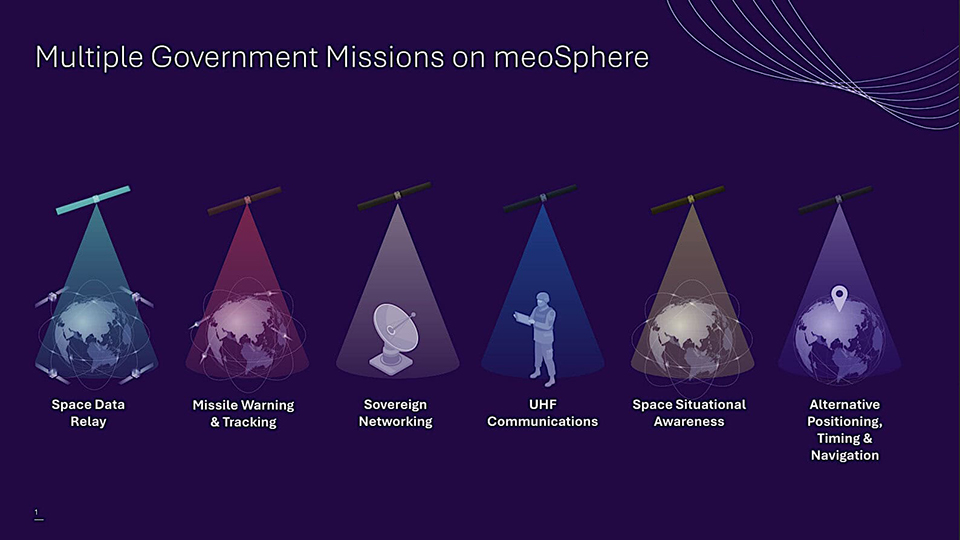
Al-Saleh was speaking at the GovSatCom 2026 Conference in Luxembourg on February 26 and where he confirmed the timing of the test with K2 Space. He explained that the new concept would permit an SES satellite to perform multiple ‘hosted payload’ missions in space including optical data relays, missile warning & tracking, UHF communications, Positioning, Navigation and Timing (PNT) was also a potential addition as well as a satellite performing its traditional communications and transmissions obligations.
This first K2 demo flight is due this Spring and will be carried on the SpaceX Transporter 16 mission. The second flight is expected in 2027 and a third in 2028. Then, after these three tests, K2 will build a fully specified satellite for SES and which should be “agile, manoeuvrable and flexible,” stated Al-Saleh, and very much de-risked.
Al-Salah also recognised the value of low Earth orbiting (LEO) satellites and their constellations but would be concentrating on its MEO (mPOWER) fleet while working with LEO operators (such as Starlink). SES is working with Starlink frequently on its aircraft and maritime connections, while Intelsat also has a commercial relationship with Eutelsat’s OneWeb for some LEO tasks.
“We see MEO as a strategic layer that is actually much closer to LEO than it is to GEO. We believe that orbit gives you the flexibility that we need to support the missions I talked about, in combination with LEO and GEO satellites,” Al-Saleh said.
His Luxembourg comments echo detailed planning which Al-Salah outlined at the Paris ‘World Space Business Week’ event organised by Novaspace last Fall. He explained then that the existing mPOWER MEO fleet was mostly full and that the three remaining mPOWER craft (from Boeing) were much needed on orbit. He also stressed that SES wanted new orbital positions, and solutions. He said that SES and K2 Space would have a strategic collaboration to advance the development of SES’s future medium Earth orbit (MEO) network. The collaboration combines SES’s decades of experience operating global multi-orbit networks, including its O3b mPOWER MEO network, with K2 Space’s agile engineering capabilities to co-develop future network infrastructure and technologies.
This first test K2-equipped craft will be the initial step towards rolling out SES’s future MEO network. This marks a shift in the traditional satellite industry approach, moving from legacy waterfall models to an iterative process that supports continuous innovation and responsiveness to market needs.
“Our future MEO network will evolve through agile innovation cycles,” added Al-Saleh. “By collaborating with K2 Space and other trusted innovative partners, we’re combining our solutions development experience and operational depth with NewSpace agility to develop a flexible, software-defined network that adapts to customer requirements.”
It is a matter of record that SES and its Intelsat acquisition, under Al-Saleh, have a very different strategy going forward. “We’re bringing two legacy companies together, and we didn’t want to end up with a legacy giant – the merged company is a newcomer on the scene,” Al-Saleh has said. “We’ve spoken often about our need to change our innovation cycle. It can take years to come up with specs, and five years plus to deliver on those specs. We had to change this. The industry is very competitive, and our competition is moving so much faster, which is leading to our consumers expecting more.”
SES will reveal its Full Year 2025 results today, March 2.