
It’s time to take stock of the space heavy hitters; where they stand now and what the future looks like.
The SDA Pivot
Northrop Grumman is currently the most successful of the traditional trio in adapting to the “Proliferated Warfighter” model. While its legacy space revenue saw an 8% dip in 2025, it is projecting a recovery to $11 billion in 2026 sales.
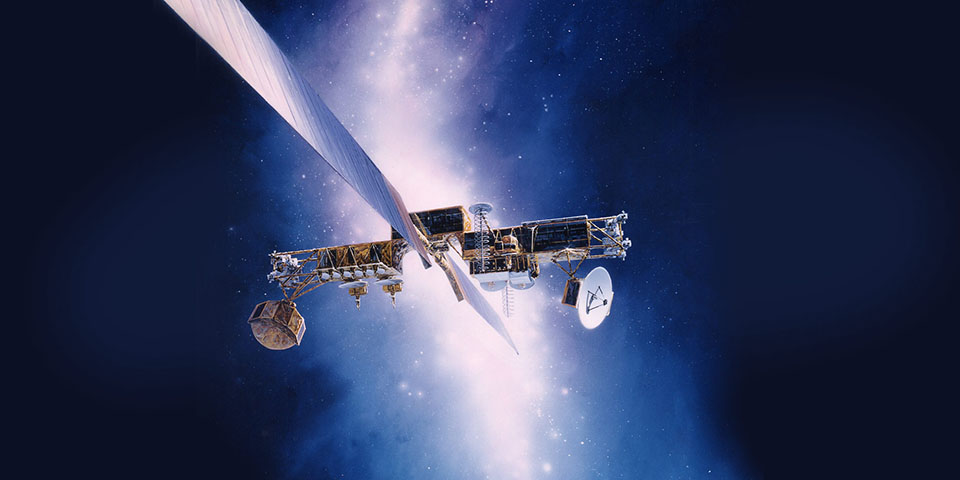
- Key Asset: It has become a primary builder for the Space Development Agency (SDA), with contracts to build over 150 satellites across the Transport and Tracking layers.
- The Trend: They are moving away from building a few “billion-dollar school buses” (large GEO satellites) toward mass-producing “spiral development” satellites at their Redondo Beach Space Park.
The Sovereign Shield
Lockheed Martin remains the world’s largest pure-play defense contractor. Its space division is increasingly focused on missile defense and deep space exploration.
- Key Asset: The Artemis II Orion spacecraft and the Next-Generation OPIR (Overhead Persistent Infrared) satellites, the first of which is scheduled for launch in March 2026 after a year-long manifest delay.
- The Policy Role: Lockheed’s “21st Century Security” vision positions space as the “connector” for a global missile shield (the Golden Dome), ensuring they remain the primary partner for the U.S. Space Force’s command-and-control systems.
The Struggle for Reliability
Boeing’s space division (BDS) is under intense scrutiny. Following the 2024 Starliner “Type A” mishap, NASA has publicly criticized Boeing’s engineering culture, and the future of its crewed flight program remains uncertain as of February 2026.
- The Joint Venture: United Launch Alliance (ULA), the Boeing-Lockheed joint venture, is currently at a crossroads. Despite a record backlog, the Vulcan Centaur rocket has faced anomalies in 50% of its first four flights, leading to rumors of a potential sale or structural breakup of the partnership.
Billionaire Competition vs. National Security
The “two billionaires” (Elon Musk/SpaceX and Jeff Bezos/Amazon) have indeed captured the Launch and LEO Broadband markets, but the traditional primes still hold the “Sovereign-Commercial Nexus” in three critical areas:
- Nuclear Deterrence & Early Warning: Lockheed and Northrop still build nearly all the sensors and interceptors that monitor ICBM threats.
- Deep Space Habitats: Boeing remains the lead integrator for the International Space Station and is a major contractor for the SLS (Space Launch System).
- High-Security ISR: While Starlink provides bandwidth, the traditional primes build the highly classified, hardened imaging and signals intelligence (SIGINT) payloads used by the NRO and Space Force.
The Policy Shift: From “Cost-Plus” to “Fixed-Price”
The real shift isn’t just who owns the companies, but how the government buys from them. The U.S. Space Force has largely moved away from the “Cost-Plus” contracts that Boeing and Lockheed once relied on.
Thia significant shift is the transition from government-funded research to self-funded technology demonstrations. In an era where the U.S. Space Force and the Department of Defense prioritize speed over bureaucracy, legacy firms can no longer wait for a formal contract to begin development. For example, Lockheed Martin has recently invested in its own internal prototyping centers to validate technologies for the Golden Dome missile defense constellation before bidding on official phases. By shouldering the financial risk of these “Project Shadow” style pathfinders, the primes are attempting to prove their technical maturity and “bureaucratic speed” to skeptical Pentagon officials who now look to rapid-iteration models as the new gold standard.