

By Abbey White, Staff Writer, SatNews
Dispatch from SmallSat Symposium. Coverage and analysis from across the conference, tracking the forces shaping the next phase of the SmallSat market.
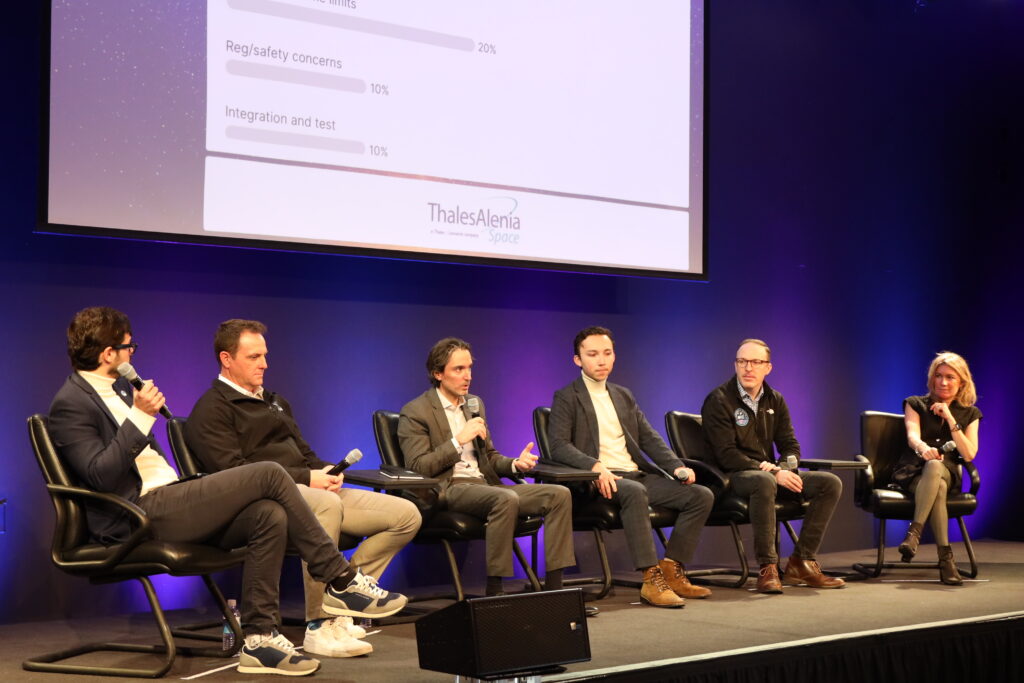
MOUNTAIN VIEW — The brochure version of the future space domain is pumped with adrenaline. The military doctrine of Dynamic Space Operations envisions satellites dodging interceptors, inspecting unresponsive objects, and performing orbital acrobatics. Yet inside the SmallSat Symposium’s session on Smart Mobility: Propulsion and Maneuverability for Agile Smallsats, the vibe waxed less cinematic. Industry leaders building engines for this revolution fixate not on backflips but on the unsexy, grind-it-out reality of reliability and supply chains.
A widening gap separates military doctrine from commercial reality. The U.S. Space Force has pivoted to a philosophy where maneuver equals defense. They want assets that move without regret. The executives on stage (representing ThrustMe, Morpheus Space, ION-X, Neumann Space, and General Galactic) painted a picture of a far more conservative customer base.
The Agility Myth
Clement Cangelosi, Head of Sales at France’s ThrustMe, dismantled the room’s assumption that agility drives sales. While the industry assumes operators are desperate for rapid collision avoidance, data suggests otherwise.
“Of course they have collision avoidance and rapid maneuvers in their delta-V budget analysis. But it’s not what’s driving the discussion,” Cangelosi argued.
For the vast majority of commercial constellation operators, the priority is not sprinting capability but a certainty that the thruster will activate after three years of dormancy in a cold vacuum. The demand for proven heritage has become so intense that Cangelosi described his job as matchmaking between risk-averse clients and successful users.
“I have to be the Tinder of propulsion,” Cangelosi said. “I have to match my customers to tell them, look, we’ve achieved this with this customer. Let’s talk with the other customer that wants to do it.”
This conservatism creates a paradox. High-agility maneuver technology exists. The research brief circulating the conference highlights the shift from static orbits to Kinetic Constellations. However, the commercial market hesitates to pay for the capability unless it comes with a zero-failure guarantee.
The Supply Chain is the Weapon
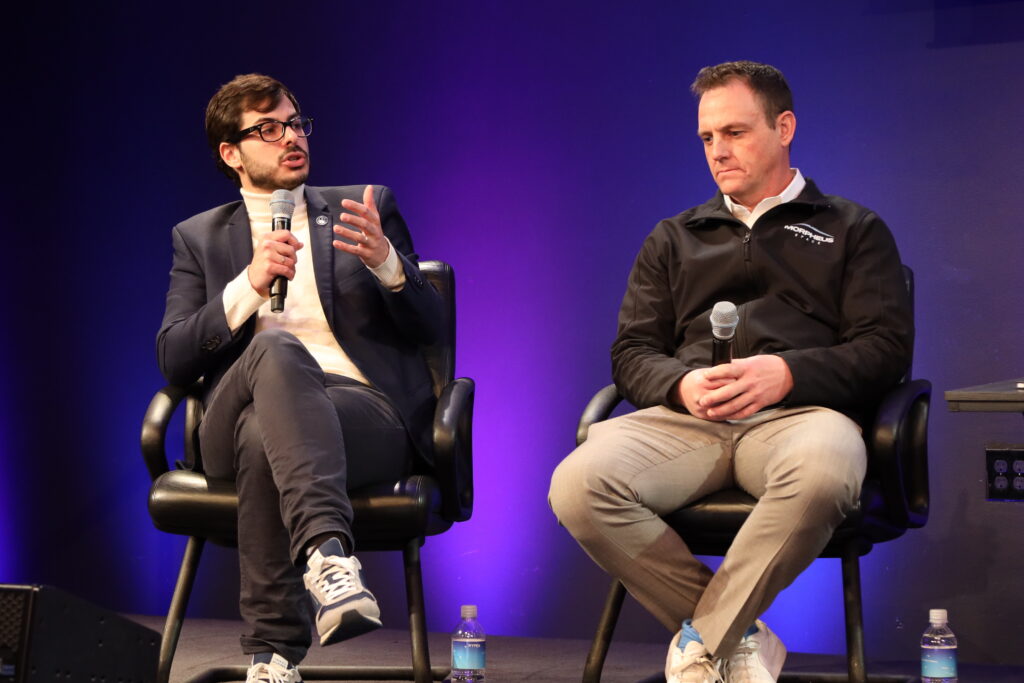
Discussion quickly pivoted to the elephant in the room: sovereignty. Physics metrics like specific impulse and thrust density are increasingly secondary to the geopolitics of fuel sourcing. The research brief explicitly identifies reliance on critical minerals such as Gallium, Germanium, and Rare Earth Elements as a systemic risk given China’s dominance over these supply chains.
Panelists reflected this anxiety. The shift away from Xenon gas (which suffered price shocks following the invasion of Ukraine) to solid propellants like iodine and metal is not just technical, it is strategic.
Thomas Hiriart, CEO of ION-X, described a French defense mission called Toutatis involving a hunter-and-prey scenario. The mission utilizes a French launcher, French satellites, and French propulsion.
“If you want to be able to have ears and eyes in the sky very quickly, you need to be able to ship that infrastructure super-quickly,” Hiriart said. “Which means you need to own the supply chain.”
Jason Wallace, VP of Business Development at Neumann Space, views this fragmentation as an opportunity. His company uses solid metal propellants like Molybdenum and Magnesium that can be sourced from Australia or the Americas, effectively bypassing Chinese mineral choke points.
“We have opportunities in other regions of the world where we’re not a US company and they want sovereign capabilities, but don’t necessarily have the full supply chain within their own country,” Wallace said.
Cost vs. Physics
Halen Mattison, CEO of General Galactic, served as the session’s provocateur. A former SpaceX engineer, Mattison challenged the panel’s focus on reliability and suggested it often serves as a convenient excuse for stagnation and bloated budgets.
“The reliability narrative is the favorite of the primes,” Mattison suggested.
His argument cuts to the core of the sector’s financial struggle. Engineering teams naturally gravitate toward the highest performance metrics, while investors and procurement officers look at the bottom line.
“Propulsion is the coolest part of space—it’s the sexy part,” Mattison admitted. “But the folks who are going to make the decisions about what flies and what doesn’t, and who are looking at the budget, are probably going to make a decision based on cost.”
Mattison characterized the current state of chemical propulsion (dominated by toxic hydrazine and expensive new alternatives) as “sad.” His company bets on water electrolysis to break the cost curve, leveraging the solar system’s most abundant resource to enable logistics over mere station-keeping.
The Regulatory Hammer
Hanging over the technical debate is the Federal Communications Commission’s new 5-Year Rule, which mandates that satellites deorbit within five years of mission completion. This regulation has effectively turned propulsion from a luxury into a legal requirement for any satellite operating above 400 kilometers.
While the panel generally welcomed the rule as a market expander, Hiriart offered a sharp warning regarding implementation. If regulators demand immediate perfection, they risk suffocating the very startups trying to solve the problem.
“If you’re saying from one day to the next every satellite operator needs to be able to deorbit within five years with a reliability of 99.9%, you kill all new EP suppliers because none of us today can demonstrate that type of reliability,” Hiriart said.
The Kinetic Constellation
The industry is caught in transition. The technology for the Kinetic Constellation is here. Iodine systems from ThrustMe are industrialized, metal drives from Neumann are flying, and water systems from General Galactic are on the horizon. The military doctrine of Dynamic Space Operations demands such mobility.
However, the commercial reality on the ground in Mountain View remains pragmatic. The winners in the next three years will not necessarily be the thrusters with the highest specific impulse. They will be the ones manufactured at scale, shipped without hazardous material waivers, and trusted to fire when the collision warning turns red.
As Mattison noted, the industry must move away from the mindset where a mission costs ten times more than anticipated.
Agility is the future. But until the supply chain is secure and reliability is absolute, the revolution will remain on the launchpad.
