
By Abbey White, Staff Writer, SatNews
Dispatch from SmallSat Symposium. Coverage and analysis from across the conference, tracking the forces shaping the next phase of the SmallSat market.
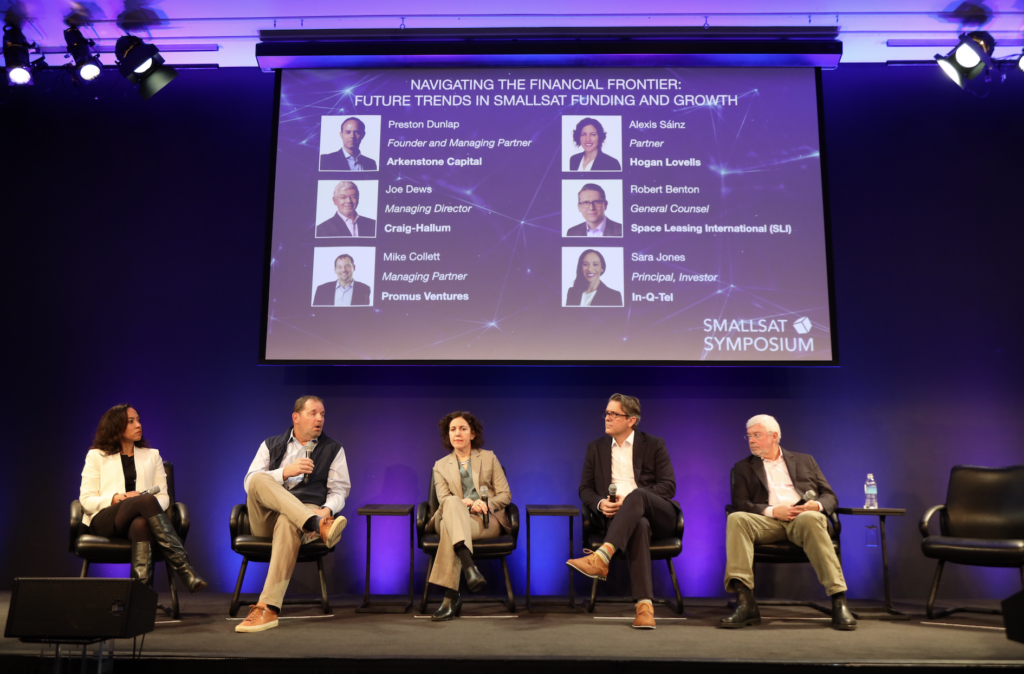
MOUNTAIN VIEW — The visionaries pitching Mars colonies have largely left the building. In their place sit investment bankers, project finance lawyers, and strategic investors who are currently rewiring the architecture of the $613 billion space economy. At this year’s SmallSat Symposium, the speculative exuberance of the SPAC (special-purpose acquisition company) boom has vanished, replaced by a mood of disciplined pragmatism. The Space Capital Markets session delivered a painful clarity to the room: the novelty of access to orbit is commoditized. Value now relies on applying traditional financial rigor to orbital infrastructure.
Preston Dunlap, former Chief Architect of the U.S. Space Force and session moderator, immediately addressed the massive valuation gap hanging over the industry. He pointed to the potential SpANGO era, a convergence of Space, AI, and Big Tech, which suggests space is finally joining the ranks of terrestrial heavyweights like NVIDIA and Meta. The data supports this view. The global space economy entered 2026 with a valuation of $613 billion, driven largely by a commercial sector that has finally achieved escape velocity from pure government dependence.
The End of the Napkin Round
The era of raising $50 million on a slide deck is over. Mike Collett, Managing Partner at Promus Ventures, offered a sobering reality check for the founders in attendance. The backlog of companies waiting to go public is long, he noted, but private markets continue to fund them because public exchanges demand legitimate earnings rather than mere projections. Collett questioned “the ability of the private capital market to continue funding companies until the cows come home. . . . There’s just zero reason for many companies to actually go out.”
Investors now demand traction and substantial scale. Collett elaborated on the sheer duration required to see returns in this sector. “It’s a very long bus ride,” Collett said. “You better like the people on the bus and you better bring some sandwiches.”
This patience is becoming a prerequisite because the market is bifurcating into a K-shaped recovery. The Upper K consists of midstream and downstream infrastructure firms, specifically those selling data or orbital services, whose valuations are stabilizing. Conversely, the Lower K is populated by launch startups and early-stage hardware companies without recurring revenue. Many of these firms face a Valley of Death as capital dries up for unproven models.
The SpaceX Effect: A Rising Tide?
The specter of a massive SpaceX valuation loomed large over the discussion. Dunlap noted rumors of a $1.5 trillion valuation, a figure that positions the company as a top-tier global asset. Yet the panelists largely rejected the idea that SpaceX sucks the oxygen out of the room. Instead, they argued, its established value validates the entire asset class.
Joe Dews, Managing Director at Craig-Hallum, contended that the narrative has fundamentally shifted from slow-moving aerospace to rapid tech disruption. “We’re now talking about commercial space, more about disruptors, more about industries changing, rapidly driven by innovation,” Dews said. He added that a huge universe of public investors currently embraces that sort of rapid change.
Robert Benton, General Counsel for Space Leasing International (SLI), was even more specific, pinpointing the exact driver of this excitement. “It doesn’t feel like it’s really SpaceX that’s doing this. It’s Starlink,” Benton said. Its mega-constellation model’s success has proven that space assets can generate utility-like returns, lifting confidence across the board.
Financial Engineering Enters Orbit
Perhaps the most significant development discussed was not a new propulsion system, but a new financial instrument: the orbital lease. SLI is pioneering an aviation-style leasing model for satellites that allows operators to convert massive upfront Capital Expenditure into manageable Operating Expenditure.
Benton described SLI’s role not as a traditional lender but a partner that buys the asset and leases it back. “We have no real interest in taking a position on one or the other,” Benton explained. “We like to spread our risk.” This model allows companies to retain equity for R&D rather than sinking it into hardware. Benton cited a deal with RBC Signals where SLI purchased ground stations and leased them back to the operator: “It became a really good financial option for RBC.”
The Strategic Safety Net
Undergirding this commercial activity is a renewed and aggressive posture from the U.S. government. The research brief highlights a Capital Cold War between the U.S. and China, noting that Chinese state-guided investment in space tripled in 2024 while U.S. startup investment contracted. To counter this, mechanisms like the Office of Strategic Capital (OSC) are deploying loan guarantees to bridge the gap.
Sara Jones, Investor at In-Q-Tel, emphasized that this government backing is not just about money; it is about survival during the long development cycles of deep tech. “Patient capital is essential for this industry,” Jones said. She stressed that venture capital timelines often do not align with physics: “It is absolutely essential that there are different types of patient capital . . . in order to get the company into a timeframe where they really start to look attractive.”
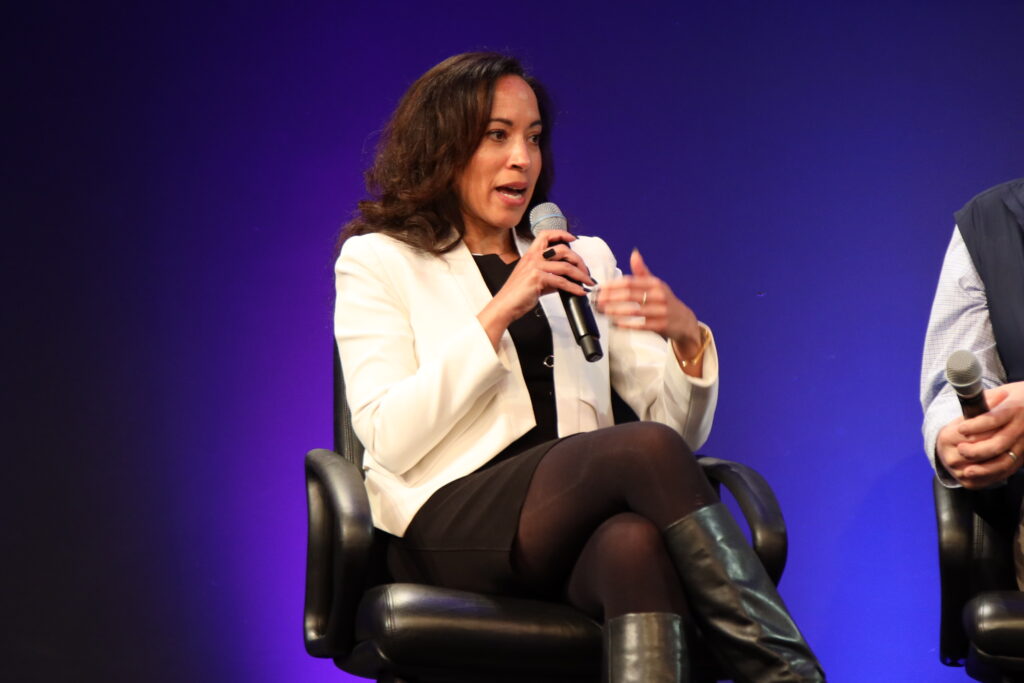
Alexis Sáinz, Partner at Hogan Lovells, pointed to the MP Materials transaction, a critical minerals deal involving the OSC, as a blueprint for space. “If you look at the ones where there’s an equity component and you look at the price, the share price where it’s gone since that government investment happened . . . up,” Sáinz stated. The message is clear: Government backing is now a signal of stability that attracts private equity rather than crowding it out.
The Wild West Evolution
The industry has moved beyond the Wild West phase, evolving into a zoned, regulated, and capitalized industrial park. Success in 2026 will not be determined solely by who builds the best rocket engine. Rather, it will depend on who can best navigate this new financial stack by combining venture capital for innovation, private equity for scaling, and asset-backed leasing for infrastructure.
Differentiation in 2026 comes from the balance sheet as much as the clean room. As Mike Collett summarized, the future is bright, but the timeline is long. “The future is very, very good, but it’s going to require patience.”