
By Abbey White, Staff Writer, SatNews
Dispatch from SmallSat Symposium. Coverage and analysis from across the conference, tracking the forces shaping the next phase of the SmallSat market.
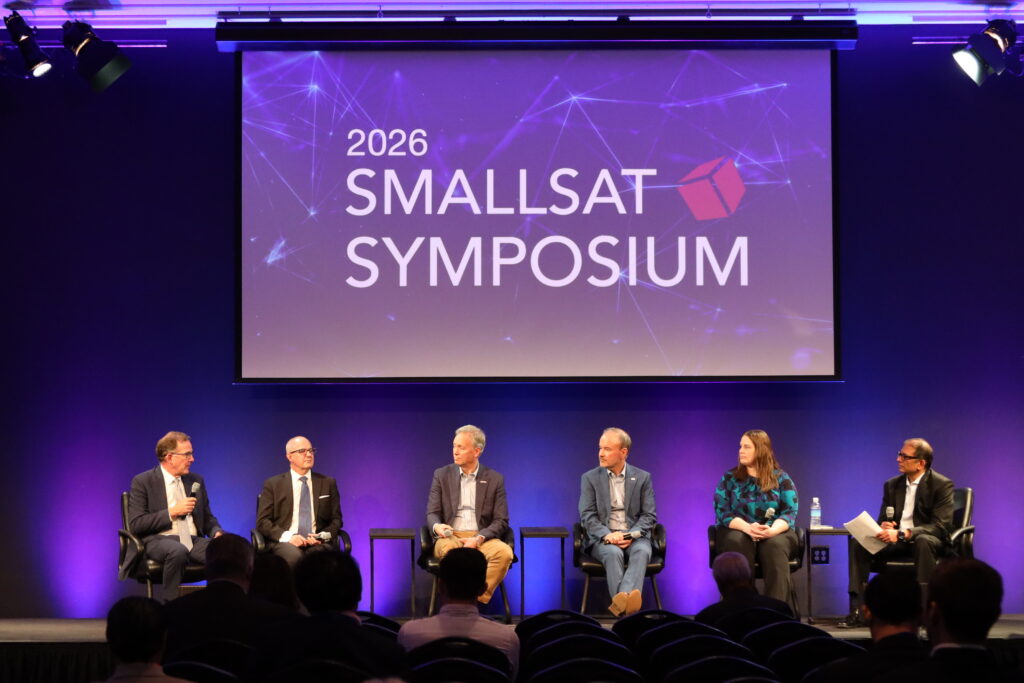
With over 14,000 satellites in orbit and filings for hundreds of thousands more flooding the International Telecommunication Union [ITU], the industry has hit a wall. Success is no longer determined by who can launch the fastest. Instead, it depends on who can find a clear frequency to talk back to Earth without being drowned out by the noise.
During the Satellite Spectrum and Regulation Discussion at SmallSat Symposium, a panel that could have provided a dry recitation of legal codes played out like a crisis briefing. Ahsun Murad, CEO of Optimal Satcom, wasted no time laying out the staggering mathematics of the current orbital environment. He pointed to massive filings coming out of China, specifically the CTC-1 and CTC-2 constellations.
Murad noted, “In total their filings exceed 200,000 satellites now.”
That number silenced the room. It breaks the traditional models of orbital management. The spectrum, once a vast and forgiving resource, has become a contested industrial corridor. The panel delivered a clear warning to those building business cases on the assumption of easily securing Ku or Ka-band rights: You are already too late.
The Regulatory Assembly Line
The U.S. government is frantically attempting to modernize its approach before the sky becomes unmanageable. The FCC’s recent Space Month initiative and the proposed Part 100 rules represent the most significant overhaul of satellite licensing in fifty years. The goal is to dismantle the static, paper-heavy Part 25 regime, designed for an era when satellites were billion-dollar monoliths that stayed in one spot for fifteen years, in favor of a system built for speed.
Karl Kensinger, Special Counsel at the FCC’s Space Bureau, described a system under immense pressure. The agency is trying to move from a bespoke, artisan review process to what the research brief describes as a licensing assembly line.
Kensinger admitted that the current regulatory systems “probably aren’t at the right pace—in fact, definitely are not at the right pace.”
Kensinger’s admission highlights a perilous gap between technology and policy. While SpaceX performs 300,000 collision avoidance maneuvers a year, regulators are still working to implement conditional grants that would allow operators to build at risk while waiting for final checks. The new Part 100 framework aims to disaggregate the review process, allowing safety and spectrum reviews to happen on parallel tracks. Yet this transition creates a fresh purgatory for companies already stuck in the queue.
The Noise Floor is Rising
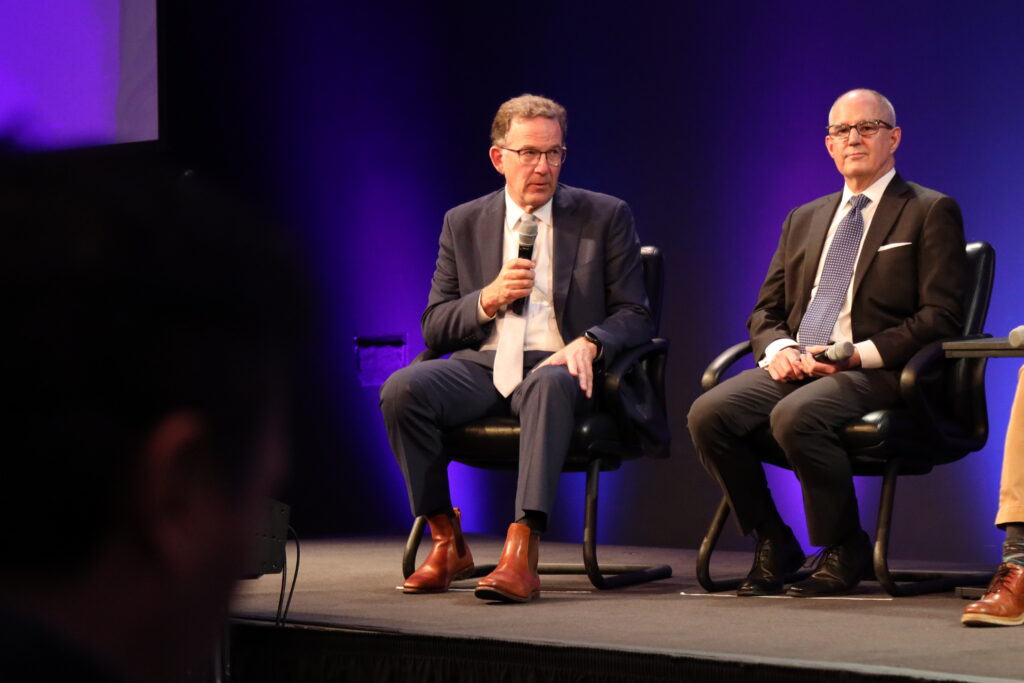
Tension rose when the conversation turned to interference. For decades, the industry has operated on the gentleman’s agreement that Geostationary (GEO) satellites are the primary residents of the spectrum, protected by strict Equivalent Power Flux Density (EPFD) limits. But with thousands of LEO satellites now screaming across the sky, that protection is fraying.
Bill Milroy, CTO of ThinKom, cut through the diplomatic talk regarding the conflict between incumbent operators and new entrants. While technical teams on both sides argue over whether the new constellations will degrade service for legacy users, Milroy was blunt about the physical reality.
“The noise floor is going to go up,” Milroy stated. “If you’re a big dish that’s trying to operate QAM 1024 and you need 35 dB of signal to noise ratio, you do care about the noise level.”
This represents the industry’s inconvenient truth. You cannot add 100,000 transmitters to the sky without degrading the signal environment for everyone. The spectrum is a finite resource. We are reaching the limits of what traditional Ku and Ka bands can carry.
Escaping the Crunch
Confronted by this saturation, the industry is trying to engineer its way out of the trap. The panel highlighted two primary escape routes: going higher in frequency, or switching to light.
Jennifer Salmon, Chief Product Officer at Elve, argued that the only way forward is to exploit the massive, unused bandwidth in the V, W, and E bands. Her company uses nanotechnology to mass-produce Traveling Wave Tube Amplifiers (TWTAs) that can generate enough power to punch through the atmospheric attenuation plaguing these high frequencies.
Salmon explained the shift simply: “We’re all trying to do the same thing, provide more spectrum as things get tighter and tighter up there.”
On the other side of the divide is the optical camp. Jeff Huggins of Cailabs made the case that the RF spectrum is a legacy bottleneck. His firm is deploying optical ground stations that use lasers to downlink data, bypassing the ITU’s radio regulations entirely. The mesh net in the sky created by Starlink and the Space Development Agency is creating a new backbone where data hops from satellite to satellite via laser, only touching the ground where necessary.
Huggins noted, “It’s going to be necessary, just because the amount of data that’s up there.”

The Geopolitical Stakes
Underlying every technical debate in Mountain View this week is the silent pressure of geopolitical competition. The urgency behind the FCC’s reforms and the NTIA’s modernization efforts is not just about commercial efficiency. It is about occupying the high ground before competitors do. The first-mover advantage in LEO is not just about market share; it is about establishing de facto standards for orbital behavior and spectrum usage.
As Ahsun Murad’s opening statistics reminded the audience, the U.S. is not the only player with mega-constellation ambitions. If the FCC cannot streamline its assembly line to license American systems faster, state-backed entities that do not wait for public comment periods will consume the orbital shells and frequency filings.
The consensus leaving the session was grim but determined. The era of permissionless innovation where startups could launch first and ask forgiveness later is ending. It is being replaced by a regime of managed congestion, where survival depends as much on your regulatory strategy as your link budget. The sky is still open, but the price of admission just went up.