

On Monday, Jan. 26, Kongsberg Satellite Services (KSAT) announced the launch of “Vake Powered by KSAT,” a consolidated maritime situational awareness platform designed to detect, identify, and track non-cooperative or “dark” vessels.
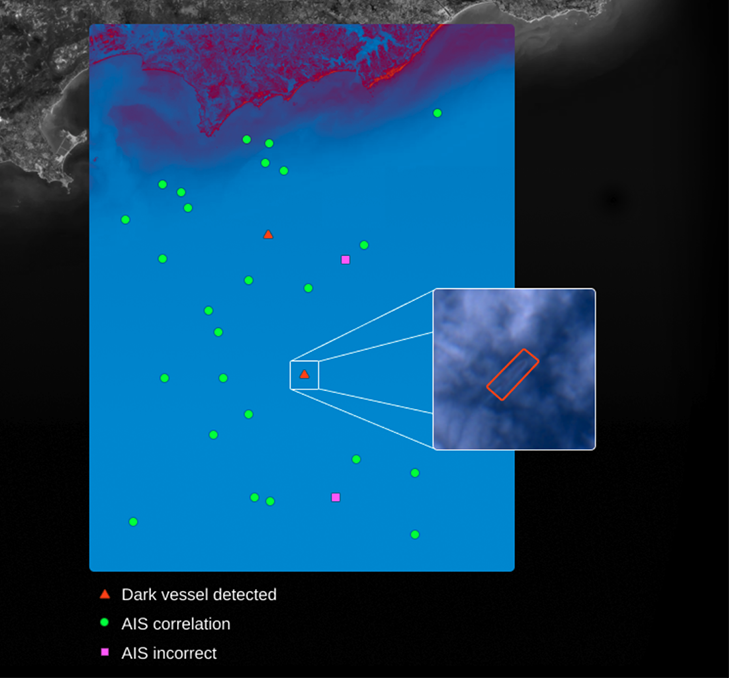
The platform integrates optical, Radio Frequency (RF), and Synthetic Aperture Radar (SAR) data from 15 different satellite providers into a single operational interface. By combining KSAT’s global ground station network with advanced Artificial Intelligence (AI), the system is engineered to provide persistent monitoring of high-traffic and remote maritime zones.
Vertical Integration and the VAKE Acquisition
The launch represents the operational maturation of KSAT’s strategic expansion into AI-driven analytics. In March 2024, KSAT acquired a majority stake in VAKE, a Norwegian startup specializing in machine learning (ML) for maritime domain awareness. The new platform utilizes this internalized value chain—spanning tasking, collection, and processing—to allow for dynamic rescheduling of satellite assets during contingency events. By leveraging a historical database and AI trained in collaboration with European navies and coast guards, the system can autonomously highlight anomalies within a specific Area of Interest (AOI).
Closing the Maritime Decision Cycle
The primary objective of the platform is to address the limitations of traditional monitoring systems, such as the Automatic Identification System (AIS), which can be deactivated or spoofed by vessels engaged in illicit activity. Space-based sensors provide a comprehensive recognized maritime picture that is often inaccessible via terrestrial patrols or Unmanned Aerial Systems (UAS). The Vake platform simplifies the space domain for end-users by offering a unified portal for data compilation and the ability to task new satellite collections on-demand.
Executive Perspective on Information Delivery
“Through our integrated value chain, KSAT delivers 15-minute collection-to-dissemination timelines across satellite operators,” stated Kristian Lindgård Knutdzon, EVP Earth Observation at KSAT. “The ambition is clear: push space-based information delivery below five minutes by 2030, regardless of operator, orbit, or platform.”
Karstein Ringjord, Director of Maritime Situational Awareness at KSAT, noted that space is a critical contributor to maritime domain awareness because it provides large-area coverage and high richness in detail. He emphasized that the platform is designed to make relevant and reliable data convenient for users to draw upon to accelerate decision-making.
Future Capabilities and 2030 Latency Targets
The roadmap for the Vake platform involves further reducing data latency and expanding the diversity of integrated data sources. As constellations continue to proliferate, the system is designed to automatically adjust collection parameters based on feature detections—such as identifying a vessel signature that does not correlate with known AIS data. This “tipping and cueing” capability will be essential as KSAT pursues its 2030 target of five-minute delivery timelines, ensuring that maritime authorities can respond to emerging threats in near-real-time.
