
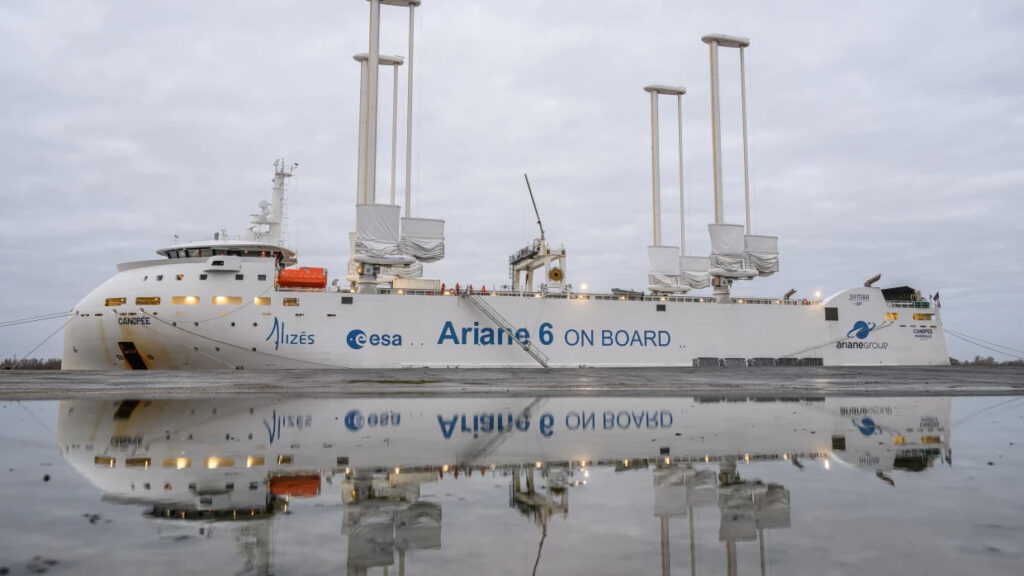
Chris Forrester — An Arianespace cargo ship, the spectacular hybrid Canopée (wind and fuel), is this week making the final rounds off the French coast picking up various elements of its next rocket ahead of the VA267 launch on a debut Ariane 64 flight with Amazon Leo satellites on board. Despite this positive news there’s considerable doubts as to Europe’s ability to get even close to SpaceX’s achievements.
The new Ariane rocket is a potential game changer for Europe: The first of the new Ariane 64 iteration, the first with 4 boosters attached, and is the first of a huge contract from Amazon’s Leo for a total of 18 launches. The Ariane 64 rocket will carry 32 Leo satellites and will take place “early” in 2026 during Q1.
The positive news is rare for European rocket activity. Indeed, this rocket is terribly late. Conceived in the early 2010s, and confirmed in December 2014 the Ariane 6 first version was scheduled to fly in 2020. That flight didn’t happen until 2024 and then suffered a partial failure. A second successful flight happened on March 6 2025.
Moreover, the original concept aimed for a partially reusable vehicle. However, the current fleet are all disposable versions. Its Ariane 62 variant has two strap-on boosters, while an Ariane 64 has four boosters (and will be used for this debut Leo launch). Costs are huge, and not helped by frequent delays. Cost of a flight is reported to be $75-$95 million per launch (although no doubt clients such as Amazon will have negotiated discounts), depending on the task in hand.
The one key advantage an Ariane rocket has is the ability to deliver its cargos much nearer their target orbits.
There’s planety of demand for the Ariane solutions, not least from European scientific and governmental missions which are more-or-less obliged to spend their investment cash within Europe. Arianespace is planning 6-8 launches in 2026.
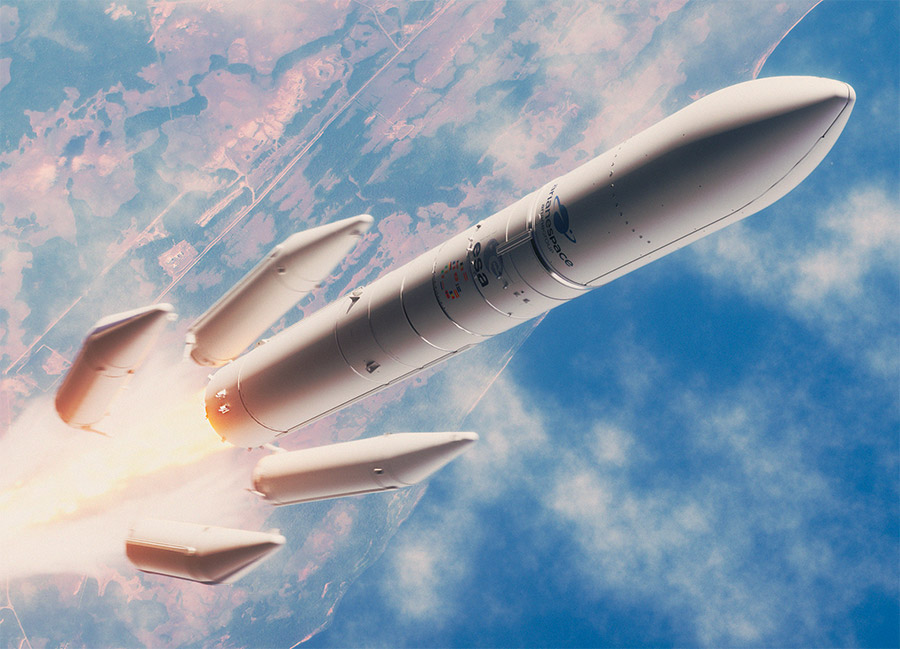
But a totally disposable rocket is hugely expensive. Observers have compared the current solution to building a Boeing 777, using it once and then throwing the aircraft away!
A December 10 report from McKinsey & Co bluntly said that Europe’s launch and space eco-systems have been “eroded” and that the US (and China) have outpaced growth in the European market in recent years. “Consequently, although Europe has a historically diversified and technically advanced space ecosystem, the continent is facing mounting challenges to its global competitiveness.”
McKinsey reminds clients that back in the day (2003-2017) Ariane the world with 82 successful consecutive launches. There was competition, of course, notably from Russia’s Proton and Soyuz vehicles. The report says that European space is being “outpaced” by other markets and “not helped by a growing gap including fragmentation in Europe’s public spending system and subscale private investments”.
The rival numbers today are telling: in 2024, for example, the US managed 154 launches and China 68. 2025 is likely to be even more with SpaceX alone handling 160 launches as at December 10.
The solution, suggests McKinsey, is more cash, of course, but also it urges Europe to pool its resources and direct efforts toward Continent-wide projects (like the IRIS2 mega-constellation). McKinsey says more private investment is needed and that the money goes to pan-European programs, which would see economies of scale.“
“Consolidate European legacy production systems to sustain profitability or innovate geostationary-earth-orbit (GEO) production to enable shorter lead times and at-scale manufacturing. This could safeguard the sustainability of critical sovereign space capabilities, bolster Europe’s industrial base, and mitigate the risk of erosion associated with the hybrid partnership scenario,” states McKinsey.