
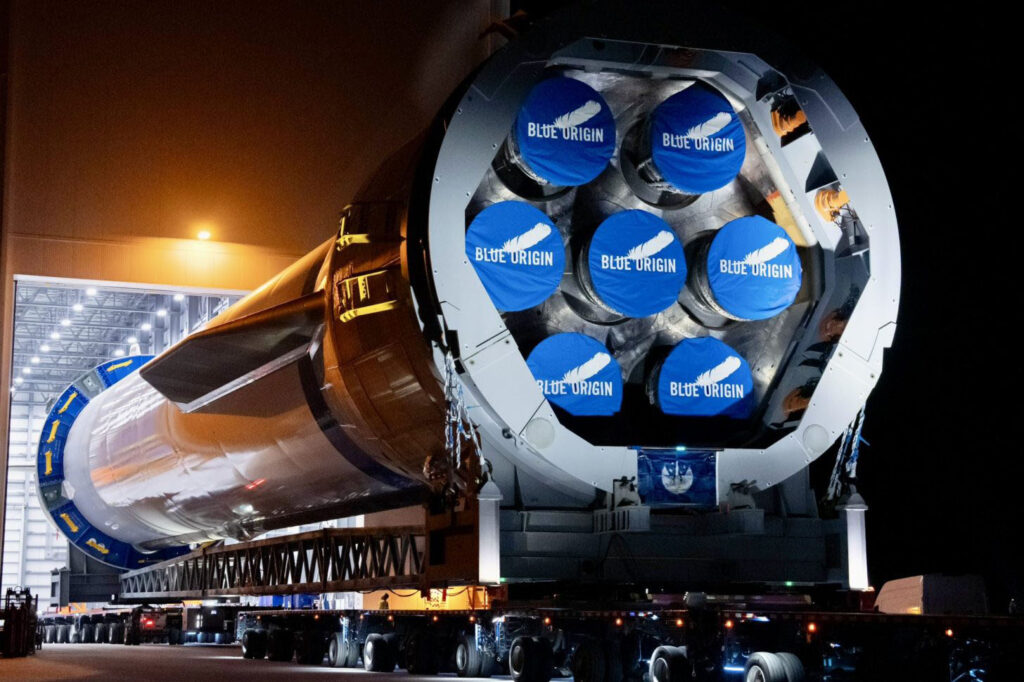
For years, the space industry whispered about the “sleeping giant” in Kent, Washington. While competitors iterated rapidly in the public eye, Blue Origin worked behind closed doors. Now, the doors are open, and the hardware is on the pad.
New Glenn is not just a rocket; it is Blue Origin’s bid to fundamentally alter the economics of heavy-lift launch and challenge the current monopoly in orbit.
The Machine: Scale and Power
Named after John Glenn, the first American to orbit Earth, this vehicle is a massive step up from the suborbital New Shepard. It is a beast of engineering designed for one primary goal: operational reusability.
- Stature: Standing at roughly 98 meters (320 feet), it looms over almost everything else at Cape Canaveral.
- The Engines: The first stage is powered by seven BE-4 engines. These burn liquid oxygen and liquefied natural gas (LNG), a cleaner-burning fuel choice that simplifies engine refurbishment compared to traditional kerosene.
- The Kick: Together, they generate approximately 3.85 million pounds of thrust at liftoff.
The Secret Weapon: The 7-Meter Fairing
While the engines get the glory, the nose cone (fairing) is the business case.
New Glenn boasts a massive 7-meter payload fairing. This offers twice the payload volume of standard 5-meter class commercial launch systems.
Why this matters: Space is volume-constrained, not just mass-constrained. This massive internal space allows New Glenn to launch entire constellations of satellites, massive optical telescopes, or deep-space habitation modules in a single trip, without needing to fold them up like complex origami.
The Landing Strategy
Blue Origin isn’t just launching; they are landing. However, unlike the “Return to Launch Site” landings often seen with Falcon 9, New Glenn is designed to land downrange on a moving vessel.
The landing platform, Jacklyn (named after Jeff Bezos’s mother), is not a barge—it is a massive, refitted ship designed to provide a stable deck in rough seas. This allows the rocket to utilize its fuel for payload lift rather than reserving a large margin for a boost-back burn.
The Market: Project Kuiper and Beyond
The immediate destiny of New Glenn is tied to Project Kuiper, Amazon’s satellite internet constellation. Amazon has booked significant capacity on New Glenn to deploy thousands of satellites into Low Earth Orbit (LEO).
This internal demand provides a “baseload” of missions that de-risks the program. It guarantees New Glenn will fly frequently, allowing Blue Origin to refine their refurbishment operations and lower costs for third-party customers, including NASA and the US Space Force.
The Verdict
New Glenn represents the transition of Blue Origin from a research and suborbital tourism company to a heavy-lift orbital logistics provider.
It enters a market hungry for capacity. With the retirement of the Ariane 5 and the Atlas V, and the growing demand for bandwidth in LEO, the world needs a second heavy lifter and the hope is New Glenn is ready to answer the call.