

• Skip to primary navigation
  • Skip to main content
  • Skip to primary sidebar
  • Skip to secondary sidebar
  • NEWS:
  • SatNews
  • SatMagazine
  • MilSatMagazine
  • SmallSat News
  • |     EVENTS:
  • SmallSat Symposium
  • Satellite Innovation
  • MilSat Symposium
  • SmallSat Europe

SatNews

  • LATEST
  • EXPLORE ⌄
    • Missions & Constellations
    • Business & Finance
    • Military & Defense
    • Launch
    • Software Automation & Ground Systems
    • Government & Regulation
    • Services & Applications
  • Magazines
  • Events
  • Jobs
  • Calendar ⌄
    • IN PERSON
    • VIRTUAL
  • Subscribe

Boeing’s new autonomous anti-jam capabilities for U.S. Space Force SATCOM program

November 15, 2022

A U.S. solider uses a communication terminal during network evaluation event in White Sands, NM. Boeing’s PTS-P recently proved it can allow U.S. and allied forces to maintain connectivity in contested environments by autonomously re-shaping beams to null adversary jamming attempts. (U.S. Department of Defense photo by Claire Schwerin)

Boeing engineers recently demonstrated a new, autonomous technology that can successfully prevent jamming attempts on U.S. Department of Defense satellite communications (SATCOM). The test was conducted on the U.S. Space Force’s Protected Tactical SATCOM Prototype (PTS-P), showing how this technology can provide secure communication in contested environments.

“Maintaining communication with our deployed forces during hostility gives us a tactical edge on the battlefield,” said Justin Bruner, PTS-P Program Manager at the U.S. Space Force. “Our adversaries are always attempting to deny our ability to communicate. On-board, autonomous, real-time nulling of jammers greatly enhances our resiliency, ensuring the United States and our allies can provide our warfighters with secure, reliable communications in a contested environment. Boeing has made significant strides in the development and execution of a nulling algorithm with flight-like firmware, demonstrating agile anti-jam capability. PTS-P and all of our Protected Anti-Jam Tactical SATCOM (PATS) programs are critical to this effort.”
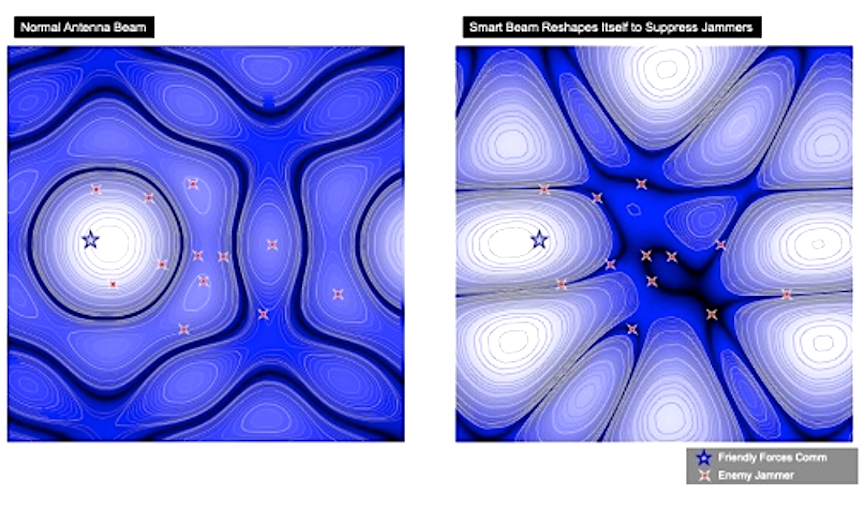
Boeing engineers recently demonstrated its space-based smart antenna technology, which detects enemy jammers and autonomously reshapes a satellite’s beams to suppress hostile jammers while maintaining communications with the friendly-force PTS terminals. Boeing’s system brings communication to the warfighter at closer range to the enemy. (Boeing photo)

PTS-P will provide space-based processing of the Protected Tactical Waveform (PTW), the U.S. military’s jam-resistant waveform. Boeing’s solution uses software-defined beam-shaping to geolocate and actively suppress jamming in real-time, with thousands of data points gathered every second.

The hardware-software integration demonstration featured a number of simulations where an adversary attempted to block a user’s communication, including situations with numerous simultaneous jamming attempts. In every simulation, the Boeing-built prototype autonomously mitigated highly-dynamic jamming attempts and preserved connectivity, including situations where the user was in close proximity to the interference source.

The U.S. Space Force has dubbed PTS-P a “pacesetter program” to signify the rapid prototyping approach and quick delivery timeline under the Space Enterprise Consortium’s (SpEC) OTA contracting mechanism. Additional PTS-P hardware and software demonstrations are planned in the coming months, with host vehicle integration set to begin early next year.

Boeing engineers recently demonstrated its space-based smart antenna technology, which detects enemy jammers and autonomously reshapes a satellite’s beams to suppress hostile jammers while maintaining communications with the friendly-force PTS terminals. Boeing’s system brings communication to the warfighter at closer range to the enemy. (Boeing photo)

“The Space Force understands these rapid prototyping programs are needed to maintain technical and space superiority,” said Troy Dawson, vice president, Government Satellite Solutions at Boeing Defense, Space & Security.

“We are innovating to meet the needs of the evolving threat. This requires us to try things that we’ve never tried before, moving quickly, failing quickly, and ultimately fielding first-of-its-kind technology that is ready for the rigors of the battlefield. Our efforts on PTS-P are setting the pace, and blazing a trail that I anticipate many more national security programs will follow.”

Boeing’s PTS-P solution is scalable and hostable on both commercial or government space vehicles. The team has completed several hardware and software demonstrations, working towards a 2024 launch and ensuing on-orbit demonstrations.

Filed Under: MILSATCOM, National Security Programs

Primary Sidebar

Coverage

  • Missions & Constellations
  • Business & Finance
  • Military & Defense
  • Launch
  • Software Automation & Ground Systems
  • Government & Regulation
  • Services & Applications

Most Read Stories

  • Global Shift Toward Sovereign Launch Gains Momentum Amid Geopolitical Tensions
  • SES Executive Confirms End of the 15-Year Satellite Era
  • SpaceX Unveils ‘Stargaze’ System to Revolutionize Space Traffic Management
  • The Space Data Layer is Coming, Just Not as Fast or as Small as You Think
  • Space Has a Plumbing Problem, and It’s Getting Expensive

About Satnews

  • Contacts
  • History

Archives

Secondary Sidebar

We use cookies to ensure that we give you the best experience on our website. If you continue to use this site we will assume that you are happy with it.
x
Sign up Now (For Free)
Access daily or weekly satellite news updates covering all aspects of the commercial and military satellite industry.
Invalid email address
Notify Me Regarding ( At least one ):
We value your privacy and will not sell or share your email or other information with any other company. You may also unsubscribe at anytime.

Click Here to see our full privacy policy.
Thanks for subscribing!