
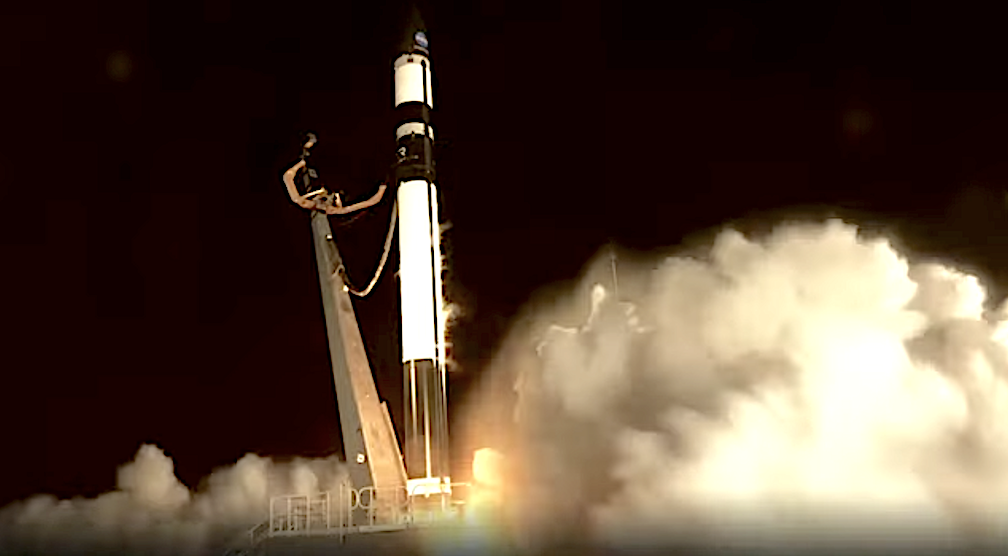
“Today we successfully launched the first of two back-to-back launches for NASA’s PREFIRE (Polar Radiant Energy in the Far-InfraRed Experiment) climate change-focused mission.”
The following announcements are from both Rocket Lab and NASA.
After a slight delay at T-12 minutes due to ‘ground winds’, Rocket Lab USA, Inc. (Nasdaq: RKLB), a provider in launch services and space systems, today launched the first of two back-to-back launches for NASA’s PREFIRE (Polar Radiant Energy in the Far-InfraRed Experiment) climate change-focused mission.
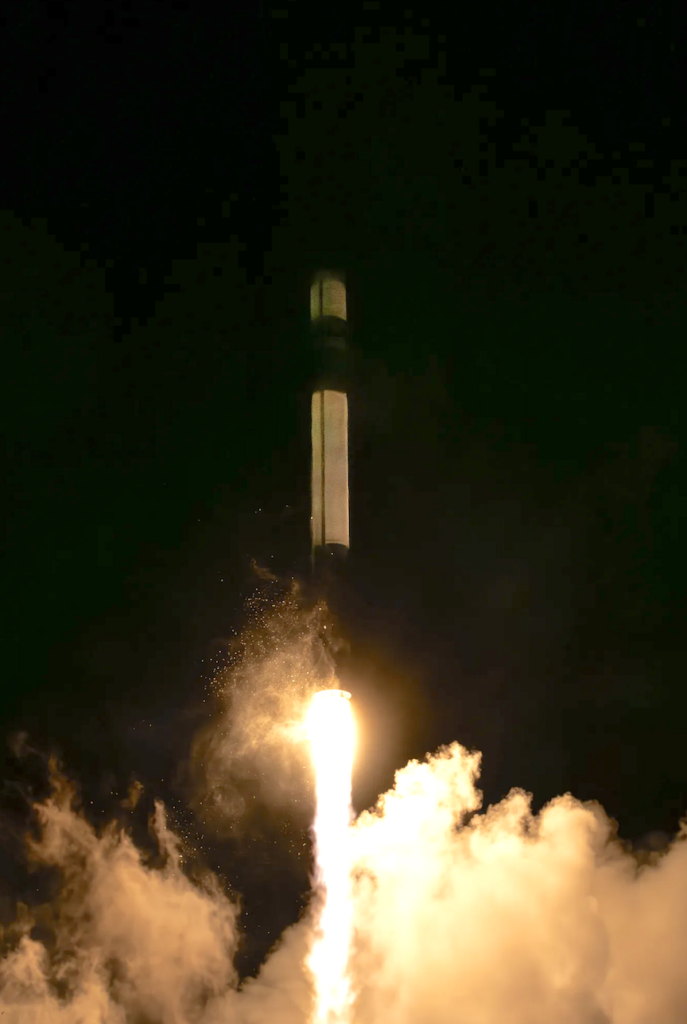
‘Ready, Aim, PREFIRE’ lifted-off from Rocket Lab Launch Complex 1 in Mahia, New Zealand at 7:41 pm NZST on May 25th, 2024. The launch deployed the first of two satellites for the PREFIRE mission to a 525km circular Low Earth Orbit. Now that the first satellite has been successfully deployed, the second will follow on another dedicated Electron launch in just a few days. The launch date for the next mission, ‘PREFIRE and Ice’ will be confirmed early next week.
Rocket Lab’s ability to launch dedicated missions to precise orbits on demand is critical to the success of PREFIRE. The mission requires two separate satellites to follow similar trajectories but along different paths to overlap with each other every few hours near the Arctic and Antarctica and capture accurate heat loss measurements. Both PREFIRE satellites are equipped with a device called a thermopile, similar to sensors found in household thermostats, to measure heat loss at far-infrared wavelengths which have never been systematically measured before. This data collected by the PREFIRE mission will help to improve climate and ice models and provide better predictions of how the planet’s sea level and weather are likely to change in the future.
Rocket Lab founder and CEO, Peter Beck, says, “Missions like PREFIRE demonstrate the unique benefit of Electron – dedicated launch for small satellites to precise orbits on precise schedules. We’ve demonstrated this back-to-back launch capability for NASA once before with the TROPICS mission and we’re excited to deliver it once again for PREFIRE. Climate change-focused missions like this are essential to understanding and safeguarding the future of our planet. It’s a privilege to support them on Electron.”
Today’s successful mission was Rocket Lab’s 48th Electron launch overall and sixth launch of 2024.
NASA Launches Small Climate Satellite to Study Earth’s Poles
Rocket Lab
The first of a pair of climate satellites designed to study heat emissions at Earth’s poles for NASA is in orbit after lifting off atop Rocket Lab’s Electron rocket from the company’s Launch Complex 1 in Māhia, New Zealand at 7:41 p.m. NZST (3:41 a.m. EDT) on Saturday.NASA Launches Small Climate Satellite to Study Earth’s Poles
The agency’s PREFIRE (Polar Radiant Energy in the Far-InfraRed Experiment) mission consists of two shoebox-size cube satellites, or CubeSats, that will measure the amount of heat Earth radiates into space from two of the coldest, most remote regions on the planet. Data from the PREFIRE mission will help researchers better predict how Earth’s ice, seas, and weather will change in a warming world.
“NASA’s innovative PREFIRE mission will fill a gap in our understanding of the Earth system – providing our scientists a detailed picture of how Earth’s polar regions influence how much energy our planet absorbs and releases,” said Karen St. Germain, director of NASA’s Earth Science Division in Washington. “This will improve prediction of sea ice loss, ice sheet melt, and sea level rise, creating a better understanding of how our planet’s system will change in the coming years — crucial information to farmers tracking changes in weather and water, fishing fleets working in changing seas, and coastal communities building resilience.”
Ground controllers successfully established communications with the CubeSat at 8:48 EDT. The second PREFIRE CubeSat will set off on its own Electron rocket from Launch Complex 1 in the coming days. Following a 30-day checkout period during which engineers and scientists will make sure both CubeSats are working normally, the mission is expected to operate for 10 months.
At the heart of the PREFIRE mission is Earth’s energy budget — the balance between incoming heat energy from the Sun and the outgoing heat given off by the planet. The difference between the two is what determines the planet’s temperature and climate. A lot of the heat radiated from the Arctic and Antarctica is emitted as far-infrared radiation, but there is currently no detailed measurement of this type of energy.
The water vapor content of the atmosphere, along with the presence, structure, and composition of clouds, influences the amount of far-infrared radiation that escapes into space from Earth’s poles. Data collected from PREFIRE will give researchers information on where and when far-infrared energy radiates from the Arctic and Antarctic environments into space.
“The PREFIRE CubeSats may be small, but they’re going to close a big gap in our knowledge about Earth’s energy budget,” said Laurie Leshin, director, NASA’s Jet Propulsion Laboratory in Southern California. “Their observations will help us understand the fundamentals of Earth’s heat balance, allowing us to better predict how our ice, seas, and weather will change in the face of global warming.”
The mission’s CubeSats each carry an instrument called a thermal infrared spectrometer, which use specially shaped mirrors and sensors to measure infrared wavelengths. Miniaturizing the instruments to fit on CubeSats necessitated downsizing some parts while scaling up other components.
“Our planet is changing quickly, and in places like the Arctic, in ways that people have never experienced before,” said Tristan L’Ecuyer, PREFIRE’s principal investigator, University of Wisconsin, Madison. “NASA’s PREFIRE will give us new measurements of the far-infrared wavelengths being emitted from Earth’s poles, which we can use to improve climate and weather models and help people around the world deal with the consequences of climate change.”
NASA’s Launch Services Program, based out of the agency’s Kennedy Space Center in Florida, in partnership with NASA’s Earth System Science Pathfinder Program is providing the launch service as part of the agency’s Venture-class Acquisition of Dedicated and Rideshare (VADR) launch services contract.
The PREFIRE mission was jointly developed by NASA and the University of Wisconsin-Madison. NASA JPL manages the mission for the agency’s Science Mission Directorate and provided the spectrometers. Blue Canyon Technologies built the CubeSats and the University of Wisconsin-Madison will process the data the instruments collect. The launch services provider is Rocket Lab USA Inc. of Long Beach, California.
Rocket Lab readies back-to-back launches for NASA’s climate change research mission
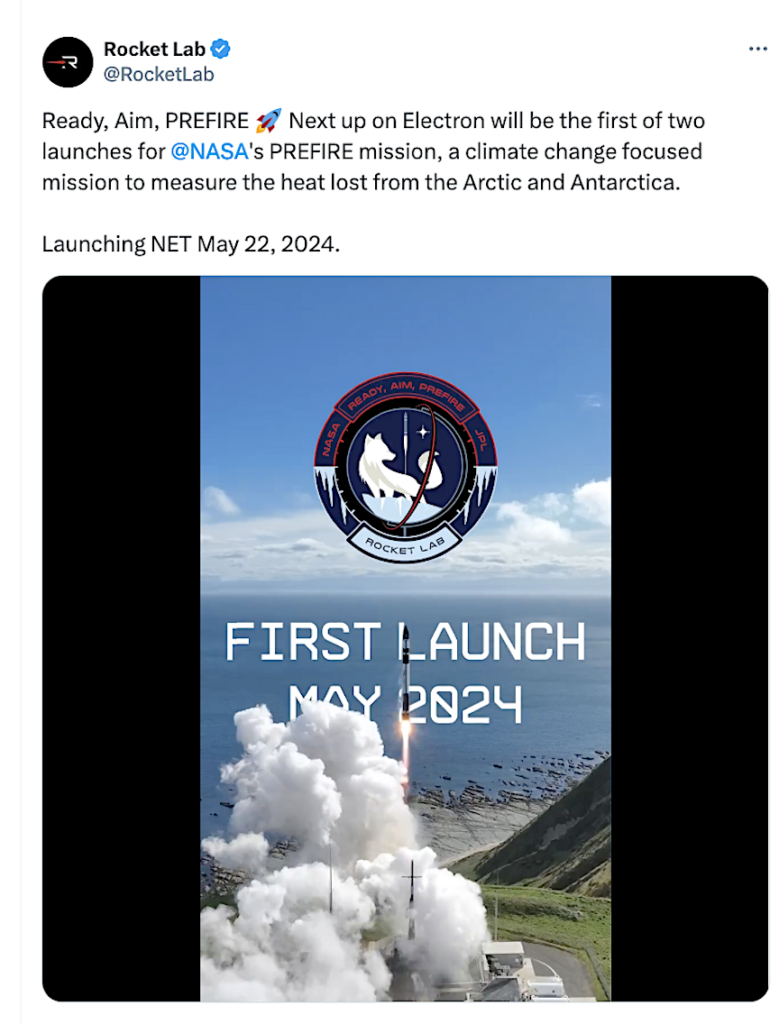

Rocket Lab USA, Inc. (Nasdaq: RKLB) global provider in launch services and space systems, announced it is preparing two back-to-back Electron launches to deploy NASA’s PREFIRE (Polar Radiant Energy in the Far-InfraRed Experiment) mission.
The two dedicated missions will each deploy one satellite to a 525km circular orbit from Rocket Lab Launch Complex 1 in Mahia, New Zealand. The first mission – named ‘Ready, Aim, PREFIRE’ – is scheduled to launch no earlier than May 22, 2024. The launch date of the second mission – named ‘PREFIRE And Ice’ – will be scheduled to take place within three weeks of the successful deployment of the first PREFIRE mission. The missions will be Rocket Lab’s 48th and 49th Electron launches overall and its sixth and seventh launches of 2024. The launch will broadcast live at www.rocketlabusa.com/live-stream
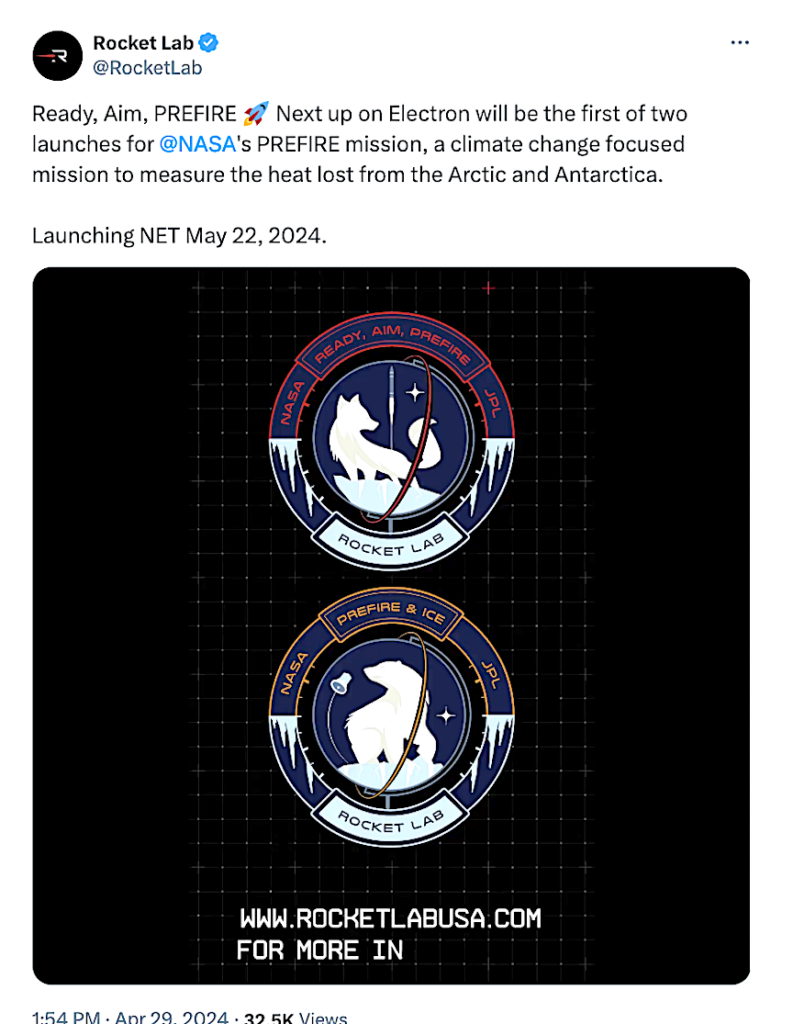
NASA’s PREFIRE mission is a climate change-focused mission that will systematically measure the heat, in the form of infrared and far-infrared wavelengths, lost from Earth’s polar regions for the first time. Extreme storms, flooding, and coastal erosion are examples of weather outcomes that are influenced by climate conditions in the Arctic and Antarctica. Once deployed to their separate orbits, the two PREFIRE satellites will criss-cross over the Arctic and Antarctica measuring thermal infrared radiation – the same type of energy emitted from a heat lamp – that will make climate models more accurate and help predict changes caused by global warming. PREFIRE consists of two 6U CubeSats with a baseline mission length of 10 months.
“Helping climate scientists better understand climate change means they need precisely located measurements of Earth’s polar heat loss, which NASA’s PREFIRE mission is setting out to achieve, and helping the PREFIRE mission achieve its science objectives means its satellites need precise and accurate deployments to their locations in space,” says Rocket Lab Founder and CEO, Peter Beck. “It’s these types of missions where Electron really thrives as the leading launch provider for dedicated small satellite missions. We have an excellent track record of delivering NASA’s payloads to exactly where they need to go and when they need to, and we’re looking forward to adding to that tally further with these next back-to-back launches.”
PREFIRE is the latest to join Rocket Lab’s list of NASA science and technology missions launched on Electron in recent years. These include the CAPSTONE mission to the Moon launched by Electron and deployed by a Rocket Lab Explorer spacecraft bus; two back-to-back Electron launches for the TROPICS mission in May 2023; the recent NASA Starling mission launched on Electron; and NASA’s ACS3 mission launched last month on a rideshare mission.
Founded in 2006, Rocket Lab is an end-to-end space company with an established track record of mission success. They deliver reliable launch services, satellite manufacture, spacecraft components, and on-orbit management solutions that make it faster, easier, and more affordable to access space. Headquartered in Long Beach, California, Rocket Lab designs and manufactures the Electron small orbital launch vehicle, the Photon satellite platform, and the Company is developing the large Neutron launch vehicle for constellation deployment. Since its first orbital launch in January 2018, Rocket Lab’s Electron launch vehicle has become the second most frequently launched U.S. rocket annually and has delivered 180+ satellites to orbit for private and public sector organizations, enabling operations in national security, scientific research, space debris mitigation, Earth observation, climate monitoring, and communications. Rocket Lab’s Photon spacecraft platform has been selected to support NASA missions to the Moon and Mars, as well as the first private commercial mission to Venus. Rocket Lab has three launch pads at two launch sites, including two launch pads at a private orbital launch site located in New Zealand and a third launch pad in Virginia. To learn more, visit www.rocketlabusa.com.